Showing posts with label JBWCA. Show all posts

Friday, November 29, 2013

John Byrne's West Coast Avengers Epilogue: Face Parade

Almost half of John Byrne's West Coast Avengers/Avengers West Coast issues open with full-page splashes of a single character's face on a blank background. If I include the close calls, like two faces on a blank background or one face with a few other details, then it's actually more than half. But as far as a simple portrait of one character from the chest up or closer in an empty space, it's seven out of sixteen. I give them to you now in order of publication:

#43 
#44

#45

#46

#51

#52 
#54
Not a good or bad thing, just something I noticed.

Wednesday, November 27, 2013

John Byrne's West Coast Avengers Part 6: Wanda's Heel Turn

Back in 1989-90, John Byrne had a 16-issue run as writer/penciler on The West Coast Avengers (renamed Avengers West Coast partway through his time on the title). I'm neither an Avengers nor a Byrne expert, but I'm aware that, at least in some circles, these comics don't have the best reputation. Screw that noise, because I quite like them, and I'm writing about them one arc at a time.

In his final two issues on this series, John Byrne doesn't get to wrap up everything, but he does finally pull the trigger on the Scarlet Witch going completely insane. After more than a year's worth of issues where nothing good ever happened to her, where everything she thought she knew about her husband and their kids was revealed to be a lie and she lost her entire family, she understandably breaks down. With some encouragement from her father, Magneto, she goes full-out villain, taking up the cause of mutant superiority an attacking her former Avengers teammates physically and psychologically. It's the logical culmination of everything else that's happened, and even though technically Byrne's run was cut short by his unexpected departure, these last two installments make it feel complete, the full tale of Wanda's gradual fall from grace.
     I like dramatic changes to a character like this if they're earned. While some of the things Wanda went through were sudden, the overall effect was a steady supply of hardship that makes her evil turn not only believable but right. She had been trying to keep it together for so long, it was time for her to snap, to react to the horrors the world dumped on her with some passion and purpose. I'm sure if Scarlet Witch was your favorite Avenger at the time, this would be more like the straw the broke the camel's back. It's the final insult added to all the injuries she's sustained while Byrne's been in charge. She doesn't just leave the team, she goes after them viciously. She kills Wonder Man and brings him back just so she can sexually assault him. She obliterates Human Torch with such finality it makes me wonder all over again why Byrne brought him back in the first place. Her former friends are left humiliated, betrayed, impotent, and terrified. It'd be the last thing you'd want to see if you were rooting for her to recover from her recent traumas, but for me it works perfectly as the nail on her coffin.
     I also like seeing a team of heroes get taken on by one of their own. It presents unique challenges for them, because they want to believe their ally will come back around. And it usually means getting totally dismantled, because the enemy already knows their secrets. That's all true here, plus with Scarlet Witch it's barely even a fight, since she's pretty much the most powerful Avenger around, and I enjoy watching the good guys get brought so low in such short order. There isn't even any time for them to bounce back before Byrne leaves the book. His legacy ends with Wanda walking away victorious and smug, the rest of the team watching helplessly. After so many issues of Wanda hitting a string of new lows, she gets to bring everybody else down to her level. It's tidy.
     The whole Tigra thread is left dangling. We find out here that she's escaped the glass box in which Pym was holding her in his lab, but where she goes is never revealed. That's the worst part of this run, sort of the opposite example of Wanda's story. Where Tigra never gets proper attention or any closure, Wanda is more or less the star of this book during Byrne's era, and her narrative gets to end. Of course, this is not the true end of either character's respective stories, since there've been more than twenty years of comics since then, including some pretty heavy stuff for Wanda. But within the tiny timeframe of Byrne writing and penciling this book, they could not have been handled more differently.
     It doesn't seem like you'd have a shortage of material to pull from if you were the creator(s) following Byrne on the comic. He leaves a lot of stuff open-ended, like Iron Man semi-forcing himself onto the team, Hank Pym and Janet Van Dyne being an official couple again, etc. Quicksilver even shows up at the very end, pretending to partner up with Magneto and the now-villainous Wanda, but clearly secretly working for the heroes in some capacity. I assume Byrne had his own plans for how that would play out, but whoever inherited the title from him had to resolve it one way or another. The point is, say what you want about whether or not he should have made the kinds of intense changes he did, Byrne definitely left the West Coast Avengers in an interesting and complicated place.
     I guess at this point I'm sort of just throwing out my remaining thoughts on these 16 issues as a unit. The last two don't have much room to focus on anything other than Wanda going bad, and since that is the conclusion to the largest and most important story thread in the run, it's hard to talk about these issues without looking back and those that preceded them.
     I will say this about them specifically: Byrne's redesign of Wanda's costume is unflattering, weird, a little too sexy for no reason, and ultimately pointless. It doesn't scream "evil Scarlet Witch" or anything, it just looks like a slight twist on her old look. It's a cosmetic change for the sake of it, an arbitrary visual cue that she's different on the inside, too. It's not a horrible costume, and the one it replaced wasn't all that great, either. But it was distinct and classic and memorable, and the one she switches into is different enough to notice but similar enough to be dismissible. So that's too bad, a disappointing but minor part of the otherwise enjoyable character shake-up.
     Byrne did some questionable things, made some choices that were provocative and damaging and hard to undo. I understand why that upset folks at the time and why it still does today, but I think the dude went bold with it, and that's always applaudable, even when it fails. He knew what he wanted to do, what he thought should be different about this team, and he went for it with everything he had. It was ambitious and confident to equally impressive degrees. That's what I dig about his issues, their unapologetic ballsiness, their unforgiving dedication to uprooting and overturning the status quo. Nobody in the cast makes it out quite the same as they were when Byrne first came aboard, and for such a large group of characters (to which he added several members) that's a lot of change in a relatively short period of time. Not that making things different is difficult in-and-of itself, but Byrne did it all while still telling standard superhero action stories, keeping his cast true to their core as he pulls the rug out from under them. Doing both things at once is a more admirable accomplishment.
     With the lineup not at all like it was when he started, and Wanda completely rearranged as a character, Byrne's time on West Coast Avengers comes to a close. It was brief, daring, fun, and crazy. And hard to forget, even if you don't like it.

Monday, November 25, 2013

John Byrne's West Coast Avengers Part 5: Acts of Vengeance

Back in 1989-90, John Byrne had a 16-issue run as writer/penciler on The West Coast Avengers (renamed Avengers West Coast partway through his time on the title). I'm neither an Avengers nor a Byrne expert, but I'm aware that, at least in some circles, these comics don't have the best reputation. Screw that noise, because I quite like them, and I'm writing about them one arc at a time.

"Acts of Vengeance" was a crossover story where a whole bunch of villains, secretly being manipulated by Loki, attacked heroes they didn't usually fight. The idea was to give the good guys challenges they hadn't faced before and for which they would therefore be unprepared. Avengers West Coast was one of several titles telling the story, so the three issues involved are disconnected beats. Reading them without the other books provides a fragmented picture of the narrative, but the event is structured in such a way that consuming broken bits of it isn't confusing or unsatisfying. Each chapter highlights a single fight in the widespread, long-running conflict, so they're all self-contained adventures in addition to being small pieces of a larger whole.
     The West Coast Avengers, sometimes with the help of the main team, fight (in order) the U-Foes, Mole Man, and Loki. The first of these battles is the dullest, but it's meant as sort of a teaser of things to come. Its action is a bit low energy, because the Avengers need to be able to shut down the U-Foes quickly and without taking much damage themselves. This makes it easier to let the villains leave when one of them, Vector, shows up and exposes that the whole reason his teammates attacked the heroes in the first place was a lie. They'd been falsely led to believe that the Avengers had killed Vector in combat, so once they see him alive and well, they fall back. Pretty much as soon as they do, Mole Man's much more powerful, terrifying, and physically massive forces arrive and begin their own offensive. The Avengers deal with the bigger and more immediate threat, letting the U-Foes escape.
     Totally worth it for Byrne to do some huge panels of Mole Man's biggest minions. It makes me want to just read a Byrne-drawn comicbook where all the characters are dinosaurs, monsters, aliens, or some combination of those things. Several awesome fights take place, including Iron Man throwing a monster the size of a skyscraper into the ocean. The height of the drama comes when Wonder Man lets Mole Man blast him repeatedly with a staff to prove the Avengers didn't attack Mole Man earlier. Just like with the U-Foes, he's being deceived, which leads the Avengers to stand around and wonder who might be provoking a bunch of random villains to attack them. Luckily, they also discover that the East Coast Avengers are having similar problems, so everybody gets together to solve the mystery and defeat the foe behind the foes. But that assembling and mystery-solving actually happens in other titles, so that the epic finale to "Acts of Vengeance" can take place in Avengers West Coast.
     And as is only natural in a story that involves trickery and a gathering of Earth's Mightiest Heroes, the villain ends up being Loki. That also means Thor gets most of the glory of the victory, which is too bad, since he's not technically part of the cast of this book. But Avengers from both coasts get moments to shine over the course of the final fight, so it's a nice sprawling slugfest for the story's conclusion.
     This arc is the least connected to the rest of what Byrne does, making its place so close to the end of his run a bit bothersome. It would've been nicer if he'd had more room to push things forward after this was wrapped up, but them's the breaks. With only two left issues before his departure over disagreements with editorial or some such, "Acts of Vengeance" is his last full arc on this book. And it's not even contained within this book alone, another detail I'm not wild about. I do like the concept of this crossover, because it feels kind of inevitable. Once there are enough villains and heroes established in the world, there's bound to be somebody who tries to use them all against each other. So many supervillains are large-scale schemers, it was only a matter of time. Plus Loki's the perfect choice, the only choice, maybe, to be the guy who out-schemes them all. Big-picture, it's a strong idea, but within the pages of this particular series, it's lukewarm.
     I will say that the awkward, forced, unnatural recaps of past events that old-school comics so often catch flack for were extremely helpful in this case. Reading just one part of an event that spans several titles means I needed to have some gaps filled in my memory of what happens elsewhere. When the information is actually useful, the expositional dialogue is welcome. It's brief enough not to drag things down, and it bulletpoints all the need-to-knows so nobody gets lost. This happens in almost every issue of West Coast Avengers, and sometimes it's annoying when you read them all in a row. But there's an obvious value in the practice of making sure everyone's on board, even if it means wasting a few panels of regular readers' time.
     Anyway, these are fun issues, each one a complete, easily-digestible superhero action story. It's classic bad-guys-pulls-some-shit-so-good-guys-respond-with-might storytelling, episodic but connected to create layers of entertainment. Byrne does some of his most impressive artwork with Mole Man's monsters and Thor fighting Loki, and his writing ain't half bad either, in that he constructs this greater-than-the-sum-of-its-parts narrative quite solidly. A decent arc, but not a favorite. That comes next.

Friday, November 22, 2013

John Byrne's West Coast Avengers Part 4: Human Torch, Iron Man, and Wanda's Kids

Back in 1989-90, John Byrne had a 16-issue run as writer/penciler on The West Coast Avengers (renamed Avengers West Coast partway through his time on the title). I'm neither an Avengers nor a Byrne expert, but I'm aware that, at least in some circles, these comics don't have the best reputation. Screw that noise, because I quite like them, and I'm writing about them one arc at a time.

I guess I could have split this into two arcs: 1. the 50th-issue return of the original Human Torch, and 2. the two-part story about Master Pandemonium and the true nature of Wanda's children that also includes Iron Man returning to the team. But because Iron Man's arrival technically happens on the last page of the Human Torch issue, and there is the common theme of people being added and subtracted to the West Coast Avengers' family through all three of these issues, I am counting them as a single arc. And we're off.
     I'm not sure what the motivation was behind making Human Torch part of this team. I'm going to guess Byrne just wanted to be able to draw him, and couldn't use the Fantastic Four version since, you know, he has to be on the Fantastic Four. So instead, Byrne went back to the original android, who is revived and made a West Coast Avenger rather quickly. It only takes one issue for the team to find his burial site, turn him back on, welcome him to the group, and move onto their next problem. And once he's part of the cast, the Torch doesn't really do anything special. I mean, he helps out, but not in a way that is specific to his powers or character. He's just an extra generic good guy, making the team bigger but not necessarily better. His contributions aren't connected to his abilities, which makes his hurried addition to the lineup even stranger. That being said, Byrne does draw an awfully nice Human Torch, with the fire looking very alive and in-motion. And even when the flames are off, he's a strapping, handsome dude. It's just too bad that, narratively, having this certain character isn't significant. He could be anybody, just another set of heroic helping hands.
     Iron Man's arrival is brushed aside in even less time. For a few pages, the other Avengers are skeptical of him, because they believe he's somebody new in the armor, not Tony Stark, due to a bunch of complicated stuff from Iron Man's own book. However, just moments after he shows up unannounced at West Coast Avengers HQ, a bunch of demons start attacking everybody, so it becomes an all hands on deck situation. By the time it's dealt with, Iron Man has pretty much proven himself in the field, and so he just sticks around afterwards and nobody questions him again. As for the demons, they're sent by Master Pandemonium as a distraction so he can steal Wanda's kids without interference. And it's after he does so that things gets really interesting and twisted.
     The real story here, the main attraction, as it were, is Pandemonium's plot. He's trying to reassemble the five pieces of his soul, which Mephisto (the Marvel Universe's Satan) claims to have stolen, broken apart, and hidden somewhere. So rather than find out where Mephisto put them, Pandemonium's plan is to use Wanda's kids' souls to replace two parts of his own. And he totally pulls it off, almost too easily. By the time the Avengers follow him back to his own realm, the children are already his, and Byrne gives us the terrifying image of Master Pandemonium laughing wickedly and hold his arms out victoriously with Wanda's sons where his hands should be. They look almost like puppets, except there's no division between where Pandemonium's body stops and theirs begin. The boys' mouths are wide with fear and pain, a stark contrast to Pandemonium's self-satisfaction.
     Having a villain take control of her children is a messed up enough thing to do to Wanda at this stage on its own. She already basically lost her husband, so having the rest of her family ripped away would doubtlessly be devastating. But Byrne isn't satisfied to leave it at that. He has Mephisto show up to explain that, in actuality, it was not Pandemonium's soul that was split into five pieces, but Mephisto's. Or, well, not his soul, exactly, but his "essence," pieces of himself that kept him from being at full power. What does that have to do with Wanda, you ask? Hang on, it takes some more information to get there.
     Agatha Harkness is able to suss out somehow that Wanda's sons with the Vision are not entirely real. She never truly became pregnant, but, in reality, suffered from a hysterical pregnancy. It's just that when you have the mutant ability to change reality, a hysterical pregnancy actually does lead to a birth. So the kids are not, in fact, kids, but merely creations of Wanda's superpowers, accidental side effects of her overwhelming desire to be a mother.
     Ok, so, now we have these two seemingly unrelated developments: Mephisto's essence is scattered in five parts, and Wanda created her kids by accident with her hex power. Where things get outright nuts is in the connection between them. Apparently, Wanda is not so powerful that she can just create life out of nothing. In order to make her children seem like the genuine article, she unknowingly reached out into the universe and grabbed two of the five pieces of Mephisto, using them as the foundation upon which her kids were constructed. So after Pandemonium gets his hands on them, Mephisto reabsorbs them into himself, and Wanda loses her children forever.
     It's pretty damn awful, the biggest and most destructive of the many trials Wanda goes through during Byrne's run. It's so terrible, actually, that Byrne has Harkness erase the children from Wanda's memory, partly to strike a blow against Mephisto—this kids are still connected to the spell Wanda used to make them originally, so destroying her memory weakens them and thus weakens Mephisto—but mostly to spare Wanda the pain of realizing how much she's lost. When you need one character to prevent another character from remembering the previous events of the comicbook, you've entered some pretty dark territory.
     I like Byrne's steadfast commitment to doing as much harm to Wanda as possible. He's never pretended to be doing anything else, and this arc is the peak of the madness and tragedy. The long-running plot point of Wanda's children mysteriously disappearing is explained (it happens when she isn't thinking about them), and she's pushed to her absolute limits as a character. This is her low point as a hero, and finally places her in a position where her eventual transition back to being a villain is not only believable when it finally happens, but feels almost inevitable. So as far as what they bring to the ongoing tale of Wanda's life falling apart, these are a good few issues.
     There's also some great art here. The Avengers battling Pandemonium's demons, both at their base and then especially when they're on his turf, always looks great. Byrne does monsters, I think, better than people, something that will be seen again in the next arc when the Mole Man gets involved. Mephisto is also spot on here, his tall and wiry frame dominating whatever space he's in. And of course there's the aforementioned visual of Master Pandemonium with the kids attached to his arms, which is how he looks for many pages, all of them equal parts disturbing and fascinating.
     Unfortunately, there are some obvious problems with this story, too. For one thing, the Avengers don't get to do a whole lot. They fight a bunch of demons, but that doesn't get them very far. It is Harkness who defeats Pandemonium and Mephisto both, her ancient knowledge and magic much more effective weapons against them than anything the superheroes can do. But her final battle against Mephisto happens off-panel, with the rest of the cast watching in terror and describing what's happening. I have to assume this is a case of Byrne actually drawing the fight, being told by editorial that is was too graphic or something, and deciding that if he couldn't do it the way he wanted, he'd just ruin the scene entirely. It's a full page of characters talking melodramatically about violence we can't see. Lame.
     So the broad strokes of what goes down here are pretty good, but some of the details of how everything's done are disappointing. By the end of these three issues, the West Coast Avengers' crew has gotten two members bigger, but also one of their number has been pretty much completely disabled by all the shit she's had to deal with. They get stronger and weaker at once, an interesting end result. It'd be nicer if they were more involved in or important to this outcome, but it's a decent outcome nonetheless.

Sunday, November 17, 2013

John Byrne's West Coast Avengers Part 3: That Which Endures

Back in 1989-90, John Byrne had a 16-issue run as writer/penciler on The West Coast Avengers (renamed Avengers West Coast partway through his time on the title). I'm neither an Avengers nor a Byrne expert, but I'm aware that, at least in some circles, these comics don't have the best reputation. Screw that noise, because I quite like them, and I'm writing about them one arc at a time.

This is probably the low point of Byrne's run, just in terms of how interesting the story is. It's sort of a cool high concept, but it's not executed very well here, and I'm not sure it belongs in this book to begin with. The long and short of the story is that an entity calling itself "That Which Endures" has existed inside of all living things since the beginning of time, determining what species get to live and which ones die out. It's a sentient organism, basically, and when That Which Endures decides that a certain group has run its course, it kills off all the members to make way for the next dominant species. This is what got rid of the dinosaurs, claims the story, and now That Which Endures has a new plan to eliminate humanity so mutants can take over. Not a new goal in the Marvel Universe, not by a long shot, but this time it's a weird microscopic intelligence instead of some group of mutant extremists who are behind the plot.
     So That Which Endures kidnaps Scarlet Witch to assimilate her as the first step toward total mutant domination. It's not perfectly clear why, if That Which Endures is in everyone already, it still needs to trick and capture people in order to bend them to its will, but that is what happens. Wanda is seen by That Which Endures as powerful enough to be useful but still malleable enough to be controlled, apparently a fair assessment, as her mind is quite quickly taken over, just in time to for her to be used against Captain America and She-Hulk when they try to save her. That Which Endures takes over She-Hulk, too, and disables Cap, and none of the other East or West Coast Avengers know anyone is in danger. That leaves Hawkeye, Mockingbird, and the Great Lakes Avengers left to show up and save the day, which they do with gusto. It's actually Mr. Immortal who makes the final blow against That Which Endures, disabling its "assimilator" and thus freeing everyone from its control. With the villain defeated, the Avengers are left to wonder if That Which Endures really does live inside every living thing, making the final call about what survives and what dies off. A strange sort of existential question that is awkwardly debated for a page before the story closes.
     Meanwhile, back at HQ, Wonder Man finally says out loud that he is in love with Wanda, and Pym shrinks Tigra in self-defense after she pounces on him. The Wonder Man thing had been heavily implied before, so getting it out in the open now is the right move, as opposed to dragging it out further. And it gives Wasp and Wonder Man a few nice scenes together as friends and teammates. The Tigra bit is basically the worst of all the Tigra material, because Pym shrinking her makes it that much easier for Byrne to shuffle her offstage indefinitely. She gets stashed in a lab in her tiny form and forgotten about, by cast and creator, for a long while after this.
     What makes That Which Endures such an uninteresting opponent for this team is that, through its mind control abilities, it's able to operate in disguise as an entire college campus full of people who seem to be acting normally. There's no obvious threat there, which means it takes almost all three issues of this arc to get to any decent action. Where something more exciting might normally go, in this narrative we get That Which Endures describing itself or its plans. Or things like She-Hulk punching a wall, Wanda being assimilated (by getting covered in black goo), Cap and She-Hulk getting a tour of the fake campus facilities, and other similarly low-action scenes. Even the big battle at the end is just Avengers whomping on college kids for a few pages, plus Big Bertha trading blows with She-Hulk (easily the best part of the arc). That Which Endures is too large a problem overcome too early in its schemes to be a very entertaining supervillain. Show me a full-on war between an army of superpowered and regular folks who That Which Endures is controlling and the handful of Avengers who are somehow able to resist, and maybe you've got something. But the GLA stumbling upon a solution after being initially alerted to the danger by a faint Quinjet emergency signal just isn't as gripping.
     I do love the pages where Byrne actually draws the beginning of time and the lives of microscopic organisms. Also, later, the dinosaur panels all look great, and have some interesting and occasionally beautiful writing, too. It makes me wonder if maybe this would have been better if it was Byrne doing an original book, outside of the Marvel U, centered on the concept of That Which Endures and therefore able to more deeply explore how it thinks, feels, and accomplishes its goals. I feel like he's scratching the surface of something here in only three issues, using That Which Endures as just one more thing to throw at Wanda instead of a full-fledged idea in its own right. It could have been anything bad, as long as it happened to her, and pushed her that much closer to the breakdown she's headed for. That seems a misuse of the concept.
     The Great Lakes Avengers as the ultimate victors is a nice piece of payoff, but this is it as far as their time in Byrne's run, which is a shame. They come and go so quickly, yet show tremendous potential as heroes in their world and compelling characters in ours. No sooner do they prove their worth than the series abandons them, so while I love what they get to do in this story, it's a bummer to know this is their last hurrah. Tigra is sort of in the same boat. In addition to attacking Pym toward the end of this narrative, Tigra's first move is to go after U.S. Agent, first with violence and then romantically. Aggressively hitting on the world's biggest tightwad makes for some decent if brief comedy, and is Tigra's most human, interesting, amusing scene. It's also the last thing she does while Byrne is in charge of the book that isn't full-on animal behavior. Really, it's the last thing she does other than jumping on Pym, being trapped in a box, and then escaping from that box, the last of which happens off-panel. As I've been saying all along, she gets shafted in this run, but it's during this storyline that she has her strongest moment.
     This arc is important because it places Vision and Scarlet Witch (her especially) firmly in the starring roles of the series. The rest of the cast are tangential characters for these three issues, not even as important to the A-plot as two members of the East Coast team (a.k.a. the "main Avengers") or the entire lineup of the half-legitimate-at-best Great Lakes squad. While "Vision Quest" could have remained an isolated incident with plenty of its own fallout, through That Which Endures—not in quotes because it's not actually the name of the story, just the bad guy—Byrne is making it clear that he's not finished fucking with Wanda. It's the completion of a mission statement started in the opening narrative. For that, I like it, and I like that this is by far the least messed up thing Wanda goes through. Her journey starts out rough, goes to something hard but less permanently damaging here, and then launches full steam ahead into darkness and misery after this.

Wednesday, November 13, 2013

John Byrne's West Coast Avengers Part 2: Great Lakes Avengers

Back in 1989-90, John Byrne had a 16-issue run as writer/penciler on The West Coast Avengers (renamed Avengers West Coast partway through his time on the title). I'm neither an Avengers nor a Byrne expert, but I'm aware that, at least in some circles, these comics don't have the best reputation. Screw that noise, because I quite like them, and I'm writing about them one arc at a time.

I go gaga for the Great Lakes Avengers. They're such an indulgently goofy team, with their overly simplistic names and blatantly ripped off character designs. They've got heart, and they're all so earnest about the heroism thing. It's true they're not all three-dimensional characters (Flatman especially, but that's got to be on purpose, right?) but as a group it's hard not to find them at least amusing if not endearing. Plus as far as superpowers go, they've got some cool stuff going on. Big Bertha's secret identity being a model is fantastic, making her more powerful and effective self the one that goes counter to the classic hyper-fit female superhero form. Mr. Immortal's inability to die is awesome because of how brazen and fun-loving it makes him. Apparently discovering his immortality was an immensely freeing moment, because he's straight up wacky about throwing himself into dangerous situations. And though he has the weakest alias of all time, Doorman is an extremely useful guy to have around. He's a walking element of surprise and, if needed, escape route. Pretty great.
     I also really like how Byrne kicks the story off with the GLA already put together and in action. We get the full force of their introduction, experiencing the same surprise at their sudden existence as Hawkeye and Mockingbird go through a little later in the issue. It also makes for an opening that is equal parts hilarious and mysterious. Mr. Immortal has got great mid-fight dialogue from the beginning, so it's fun to watch him work, but at the same time, there's the question of why we're seeing this team of misfit heroes instead of the book's usual cast. That mix of immediately accessible action-comedy and curiosity-piquing new characters is great, and carries the rest of the issue.
     Speaking of which, it's smart of Byrne to only give these guys a single issue for now (#46), just to set them up so they're ready when he needs them down the line. As entertaining as they are, if this initial GLA story was spread out over two issues, even with other West Coast Avengers plotlines mixed in, I suspect it would grow annoying. The GLA are too silly to spend very much time with unless you plan on spending all your time with them, so you can flesh them out and give the silliness legs. But for the purpose of a one-off story to establish the idea of the team, they strike the perfect balance between ludicrous, likable, and interesting.
     The one-issue format does make Mockingbird and Hawkeye's decision to coach the ragtag squad of unsanctioned knock-off Avengers feel rushed and perhaps a tad unbelievable. Then again, Hawkeye's totally the kind of guy to let the momentum of his quitting a real Avengers team propel him into signing up with a fake one. And Mockingbird's last line in the issue is actually anti-GLA, scolding them for using the Avengers name without permission, so her reasons for sticking around are less clear, to say the least. She shows up to try and reconnect with Hawkeye and save their marriage, so I guess it's safe to assume that's why she stays with him when he chooses to mentor the new kids. Whatever the case, it all happens pretty quickly, which is annoying, but I still think it was the right call to make this a single issue thing. Byrne's mistake, I think, is feeling obligated to check in on other members of the Weast Coast Avengers. U.S. Agent and Tigra have a three-page scene that never really leads anywhere in Byrne's entire run (part of the bungling of the larger Tigra storyline I mentioned last time), and then the final page is devoted to Wanda...getting a letter! GASP! Super lame way to close, but apparently Byrne or someone thought it absolutely necessary to tease the next issue at the end of this one no matter how unrelated they were. Had those four pages been given to the GLA narrative that the other eighteen were focused on, I reckon Hawkeye and Mockingbird's change of heart could've been much more natural.
     I nodded to this before, but three of the five members of the GLA have their designs overtly stolen from existing characters—Flatman is Mr. Fantastic, Doorman is Spider-Man in the symbiote suit, and Big Bertha is the Blob. Admittedly, that's a weird trio of characters to use in the same place, but that isn't enough to distract from how obvious it is. I don't mind; it adds to the big joke that is this whole team. And Byrne makes them look good as a unit, able to fit them into panels together in different combinations from various angles without messing with anyone's proportions. Mr. Immortal's unhinged personality is the art's biggest and most important contribution this time out, though. It's a smaller, more intense version of his team's general dysfunction. They're not really ready for prime time superheroics, but they're trying their hardest, throwing themselves into it with everything they've got. That's all Mr. Immortal is doing when he flies off the handle, too, just to a more extreme extent. The art's low point, by the by, is Clint and Bobbi's hair before they are in costume. So hideously 80's.
     It's dumb that the only person on the GLA I haven't named yet is Dinah Soar, because her name is the best by far. She flies and she resembles a dinosaur. Brilliant. So now that's out of the way. Phew.
     Not sure how much else I have to say about this one. It's worth noting that West Coast Avengers #46 was the last issue to bear that name before the series made the switch to Avengers West Coast. I prefer the former, but I can see why you'd want "Avengers" to be the first word in any Avengers book. Makes sense from a branding standpoint. Still, the fact that the GLA issue is the last one with the original title seems fitting. It's an intentional diversion, a break from most of the main characters and their stories, so it works nicely as a transition point between the two names.

Monday, November 11, 2013

John Byrne's West Coast Avengers Part 1: Vision Quest (or is it VisionQuest?)

Back in 1989-90, John Byrne had a 16-issue run as writer/penciler on The West Coast Avengers (renamed Avengers West Coast partway through his time on the title). I'm neither an Avengers nor a Byrne expert, but I'm aware that, at least in some circles, these comics don't have the best reputation. Screw that noise, because I quite like them, and I'm writing about them one arc at a time.

John Byrne's Vision is the first Vision I ever met. This arc wasn't my introduction to him, because I didn't read Byrne's run in order as a kid (I found random issues of it amongst my dad's collection). I don't remember the exact story or scene, but I still recall the powerful impression left on me by this strange, pale, caped figure passing through a wall and being very serious. At first I thought he was a ghost, but when I found out that, no, he was a robot, it floored me, because even the simple smashing together of ghost and robot elements broke new ground for me at that age. I didn't mind his emotionless personality, because that was just a natural piece of the robot side of his character. And I certainly didn't have a problem with the all-white coloring, because that was the whole appeal—he had to physically resemble a ghost if he was going to act like a robot. His powers came from both worlds, and that was also perfect. When I did eventually learn that this take on the character came after Byrne had literally and figuratively dismantled the then-current version, that, too, just screamed "Ghost!" to me. He'd died and come back, but different, less accessible to humans. Because he's a ghost now on top of already being a robot! Awesome.
     All of this is to say that, I understand entirely why people who were fans of The Vision before this story, who liked his marriage to and family with Scarlet Witch and wanted them to be a happy, stable couple forever...I get why people in that position think John Byrne ruined the character. It really is a whole new thing, and it happens very suddenly, and once it's done, Byrne goes way out of his way to make extra sure that everybody in the comic and out understands that this is a permanent, unfixable change that nobody in ALL THE MARVEL UNIVERSE can possibly undo. He even crams in that Vision's entire origin story is a lie, which is blurted out by Hank Pym in a single panel on the second-to-last page of the final issue of this four-part arc. An arc that basically opens with a longwinded retelling of that same origin, by the way.
     The point is, yes, "Vision Quest" has its flaws, some of them large. But for me, at least, the re-creation of Vision as a monotonous, monochromatic stick-in-the-mud isn't one of them, because that's what I think of when I think of him at all.
     Also, the story's shortcomings are worth it for its high points. The two-page spread of Vision laid out on an examination table, stripped of his skin and with every tiny piece of his complex robotic body dismantled and on display, is a jarring, gut-wrenching moment because of the meticulous detail of Byrne's art. The same goes for the anger that radiates off of Hawkeye in the scenes leading up to his quitting the team, the agony both Wanda and Wonder Man go through during this story, and the excitement of all the action. Byrne does melodramatic conversation and/or contemplation just as well as he does superhero fight scenes. Since this series, and this arc especially, is basically just a back-and-forth between those two things, it all looks great. Also, Byrne is smart about when and where to place his big moments. He opens each issue on a beat of high tension, charging into the drama of his stories headfirst. Even the beginning of this first arc is Wanda waking up distressed and unable to find her husband, a fitting opening considering the rest of the narrative is pretty much just the universe shitting all over Wanda. That will be a running theme throughout Byrne's time on the book (more on that will come in later posts). For now, I'm just pointing out that "Vision Quest" is well-told visually, and that Byrne times its dramatic peaks perfectly. If only he'd taken the same care with the valleys, I think it might've been a really great beginning to his run.
     Without question, the weakest bits are when Byrne slides into over-exposition mode. He'll devote several pages to filling us in on a character's backstory, or over-inflate a few dialogue balloons in a row to remind us what happened last issue. And there are other classic 80's storytelling tactics, like characters explaining their powers to each other every time they're in a fight, or monologuing extensively about their emotions for no one's sake but the reader's. Having too many of these things tacked on can weigh the story down, and there are some rough patches in this arc for sure. Because it is Byrne's opening gambit, and he immediately rearranges the Vision's status quo, he seems to find it necessary to explain himself through his characters as often as possible. It slows things down, sometimes when they should be speeding up instead.
     Aside from its main goal of transforming Vision from loving husband to detached synthezoid jerk, "Vision Quest" sees Tigra start to succumb to her more animalistic impulses, U.S. Agent forcibly added to the team, Hawkeye quitting (basically because of U.S. Agent), and an off-panel reigniting of the romance between Janet Van Dyne and Hank Pym. Plus, of course, the early stages of Wanda's mental breakdown, and the first hints that something strange is going on with her children (again, more on that later). That's an awful lot of change in a very short space, which is ambitious on Byrne's part, but perhaps overly so. His time at the helm of this series would ultimately be cut short, and so things like Tigra's transformation were left dangling. And that thread in particular is mismanaged by Byrne from start to finish, never given the attention or consideration it deserves by anyone in the cast. It's more an excuse to leave Tigra out of the action than it is an actual plotline to be followed. One too many wrenches thrown into the works at the beginning.
     Ok, I'm skewing a bit negative here, and that's ok because these issues deserve it, but my original intention was to talk about why I like Byrne's run, so let me close on an upswing. For all its faults, this arc is nothing if not sure of itself. Byrne knows exactly what he wants to do, and even if he hasn't perfected how he's going to do it, he jumps in with great force right away. He puts faith in himself and his cast and lets the chips fall where they may after blowing up the lives of several major players. Many disagree with the results, and even I think a few of them are questionable or worse, but he gets points for his gusto and the height of his aims. Also, bringing the entire team to a collective low point right off the bat is not at all a bad way to kick off a run. It makes for a difficult uphill climb for cast and creator alike, but done well, that can be the most compelling type of fiction.
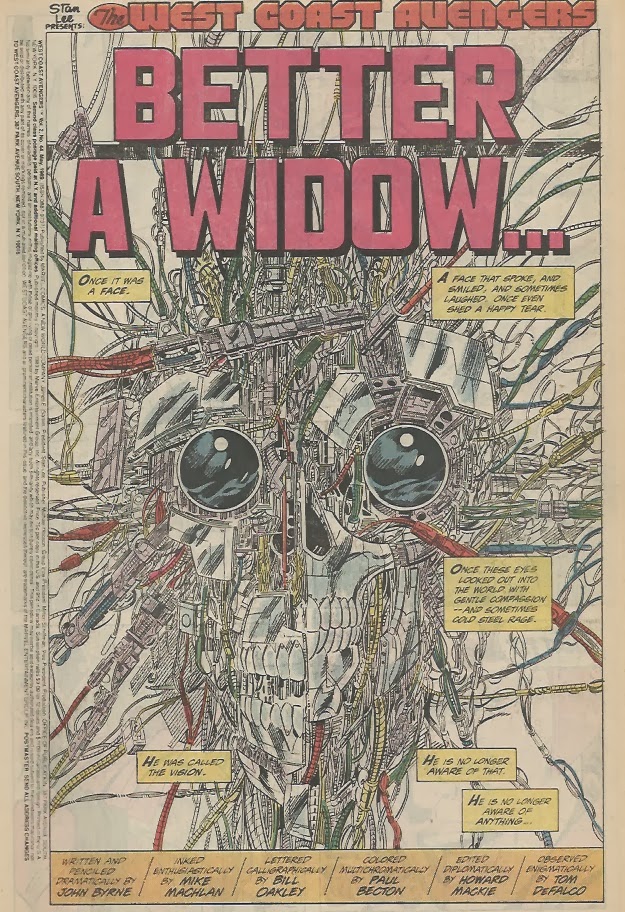
     And seriously, that two-page spread of Vision in pieces? And the full-page splash of just his face in the same condition that opens the following issue? Chilling. That Byrne would go to such trouble artistically to underline the severity of Vision's loss of self speaks to its permanence and completeness.