Showing posts with label This Exists. Show all posts

Tuesday, January 14, 2014

This Exists!: Washouts

This Exists! is a semi-regular column about particularly strange, ridiculous, and/or obscure comicbooks I happen to have stumbled across.
 In the backmatter of Washouts—I guess techincally it's Washouts #1 but since, as far as I can tell, it's the only issue ever published of this tile, I'm not going to use the number—writer/artist Michael Cohen explains how the three short stories contained within the issue came to be. Basically, he wrote them several years before as part of his development of a different comicbook concept, Strange Attractors. That book was Cohen's idea originally, but he had a hard time selling it to any publishers on his own. It was until he collaborated with Mark Sherman to more fully develop and tweak Strange Attractors that it actually got published and, apparently, received some critical acclaim. Now, I haven't read that series, so I can't properly make a comparison between the two, but I will say this: Washouts absolutely reads like a comic that would've benefitted from having someone other than Cohen providing their input. It  meanders, it fails to properly introduce its cast or their world, and two of the three stories barely have a plot, let alone a reason to exist. Nothing gets said by this comic, because it only barely manages to give its characters anything at all to do. If Cohen had even a single collaborator to give the book some purpose or drive, it's not out of the question that it might've become something worthwhile. Instead, we get this.

The concept of the title, as much as we're ever told, is that the Washouts are a team comprised of young women who flunked out of the "Academy." What that Academy trains people for is never explained, and neither is why, exactly, the cast of this book didn't cut the mustard. The Washouts themselves seem to be interstellar explorers/heroes, so maybe that's what the Academy is all about, too? I'm pretty sure it's part of the world of Strange Attractors, which I guess is why Cohen didn't feel the need to provide much information about it here, but whatever the Academy's up to, the Washouts aren't involved anymore. This doesn't stop them from having dangerous, action-packed adventures of their own, though, which makes me wonder if maybe they are operating illegally. Perhaps the Academy is how one gets licensed in this reality for a life of adventuring, and the Washouts are an underground gang of do-gooders who don't have the proper paperwork. But that's all speculation, and much of it is baseless, so instead of wondering about the possible explanations of things that aren't clear, let's look at what's actually present in this comic.
The first and longest of the three stories is "Our Typical Rotten Luck," featuring five of the Washouts (who have at least seven total members, based on who we meet in this issue). The tale opens with two members of the team, Freeda and Squinch, in a small spacecraft together and on the run from an enemy of theirs named Stargate Sally. In trying to evade Sally's far superior vessel, the Washouts end up crash-landing on an unknown planet where, in classic fashion, they are cut off from communication with the outside world. They manage to send a quick warning signal to the other Washouts so a rescue mission is launched, but in the meantime Freeda and Squinch are stranded with no way of knowing for sure whether or not their friends will save them or when. This strangers in a strange land thing is, of course, a pretty standard set-up, especially for science fiction. And Cohen doesn't stray too far from the familiar for the duration of the narrative. Freeda and Squinch meet the native species of the planet, who, predictably enough, are advanced in some ways (language, mostly) but not-as-advanced technologically. Their culture is based on their religion, which itself is based on a sacred text written in giant stone letters that can only be read if viewed from high above. Squinch inadvertently destroys one of these stones while she and Freeda are exploring, and it's a mistake that nearly gets her killed, changing the text so that instead of saying not to sacrifice outsiders, it says to sacrifice them. As such, Freeda and Squinch are locked in a holding cell where they are to be kept until it's time for one or the other of them to be killed as an offering to the gods.

Lucky for the Washouts, Stargate Sally doesn't abandon her pursuit just because her targets disappear on a mysterious world. She follows them without hesitation, able to safely land without taking the same damage the Washouts' spaceship did. At first, this seems like bad new for our heroes, who don't even realize Sally has managed to keep up her end of the chase. But once Sally meets the natives, her aggressive behavior makes her their captive as well, and their top pick for outsider to kill. So in the morning, rather than either Freeda or Squinch being selected as a sacrifice, they are both set free, not even aware that it was their old enemy Sally who their new enemies chose to kill in their place. And if that wasn't enough, the three Washouts who came to save Freeda and Squinch arrive at more or less the same time, and all five members of the group reunite at the site of Sally's spaceship, where it waits unguarded and in perfect condition for a pilot who will never return. So the Washouts use it to take their leave of the strange, harsh place, and everyone goes home happy. Except, you know, for Sally.
It's a pretty dumb story, all in all. The Washouts are depicted as obnoxious idiots, with Squinch the clumsy coward who accidentally demolishes ancient stone letters, and Freeda an arrogant, bossy bully whose reckless bravado is why they end up stranded in the first place. I see no reason to like them, and in fact I'm not positive if Cohen wants me to. They might be good guys, but they could just as easily be criminals who Sally is trying to arrest. We don't learn any of their history with Sally, or really much about her at all, so the easiest assumption to make is that the title characters are the heroes and Sally is therefore a villain. But other than Sally being kind of mean, there aren't any in-story clues as to why she and the Washouts are at odds with each other, or what the heck the Washouts are trying to accomplish as a group at all. Cohen doesn't try to make his stars sympathetic or three-dimensional, each of them only capable of displaying maybe two or three different emotions. There is no context for this narrative, no reason to care about the stakes, even though what's at risk is literally the lives of two of the protagonists. If your main characters can be hours away from death without it sparking the least bit of excitement in your reader, then you need to go back and get the basics down before diving into the details of the plot.

Which is basically my whole problem with Washouts top to bottom: Cohen never covers his bases. He lays no groundwork, has no foundation on top of which he can construct these tales. Things just happen with no rhyme or reason, and we're never told why we should give even the smallest shit about it all. The Washouts do stuff and we have no insight into why or even how. Again, I assume some of this has to do with this kind of introductory material being covered previously in Strange Attractors, but Washouts is its own series and deserves to have its reality freshly established, even if that info does technically exist elsewhere already. This is a comicbook that throws its readers into the deep end of what ends up being a very shallow pool overall.
The second story, "Another Day with Astra," is an utterly simplistic day-in-the-life story about, you guessed it, Astra, who I assume is a Washout (but who really knows/cares?) and is definitely a superhero. At only two pages, this section is essentially just an excuse for Cohen to draw a handful of disconnected stereotypical superhero scenes that are all too short to be the least bit effective. It ends with her relaxing after this long day of heroics to watch a TV show based on her life of heroics. A sort of funny ending, but none too original, and it's the conclusion of a non-narrative story, anyway. There is no plot here, just a string of events capped off with a lame gag.

Finally, there's "Make Way!" a X-page piece about a Washout named Phoebe racing against the clock to make it...somewhere on time. We don't actually know where she's headed until the story's last page reveal that it's just a hair appointment, making all her anxiety, selfishness, and law-breaking on the way there seem way more annoying than it already did. She evades law enforcement and steals a transportation pass off of a guy she knocks unconscious after carelessly plowing into him in her hurry. All so she can get to her haircut on time. It's extremely petty, and it makes Phoebe seem spoiled and vain and intensely unlikable. Not that she was all that endearing before the haircut reveal, because the whole story is pretty inane. From the start, it's just her worrying about being late, trying to use different shortcuts in this unexplained, confusing, futuristic sci-fi setting and getting more and more lost and flustered until she decides that picking the pocket of a dude she flattened is an acceptable means of getting what she wants. While the other Washouts give us no reason to root for them, Phoebe actually has me rooting against her by the end of her story, a terrible way to close an already underwhelming comicbook.
I'm not sure what Michael Cohen thought he had in Washouts. Is it meant to be a comedy? A ragtag group of young misfit space ladies having goofy/madcap escapades? That's as close to reality as I can get when trying to imagine a more enjoyable, viable version of this project, but that is still too bland and trite and lightweight. Even if the humor worked and the characters were fleshed out and the world was explained, I still don't see what would make Washouts stand out from the crowd. It reads like something that was published not because anyone really wanted to see it, but because Cohen happened to find the scripts in the bottom of some desk drawer right when he had a bit of extra free time on his hands. There's no attempt here to establish an ongoing series, or even really to carry the reader's interest from the start of any one story to its end. Washouts is empty and boring on a level I rarely encounter. But hey, it exists.

Tuesday, August 13, 2013

This Exists!: Buzz and Colonel Toad #1

This Exists! is a semi-regular column about particularly strange, ridiculous, and/or obscure comicbooks I happen to have stumbled across.
Buzz and Colonel Toad #1 was one of a small stack of 25-cent comics I picked up from a discount bin at some store somewhere several years back. I'm pretty sure a second issue of the series was published, but I've never seen it anywhere except online, so all I have is the debut. That's fine, though, since it's a self-contained story. It's a black-and-white children's comic from 1997, or at any rate I assume it was targeted at kids based on the simplicity of the language and characters. Also because it seems to want to have a moral, a valuable lesson to impart on its younger readers, though I'm not sure how well that succeeds. Partly because the whole issue is loosely put together, and partly because the underlying message is questionable at best.

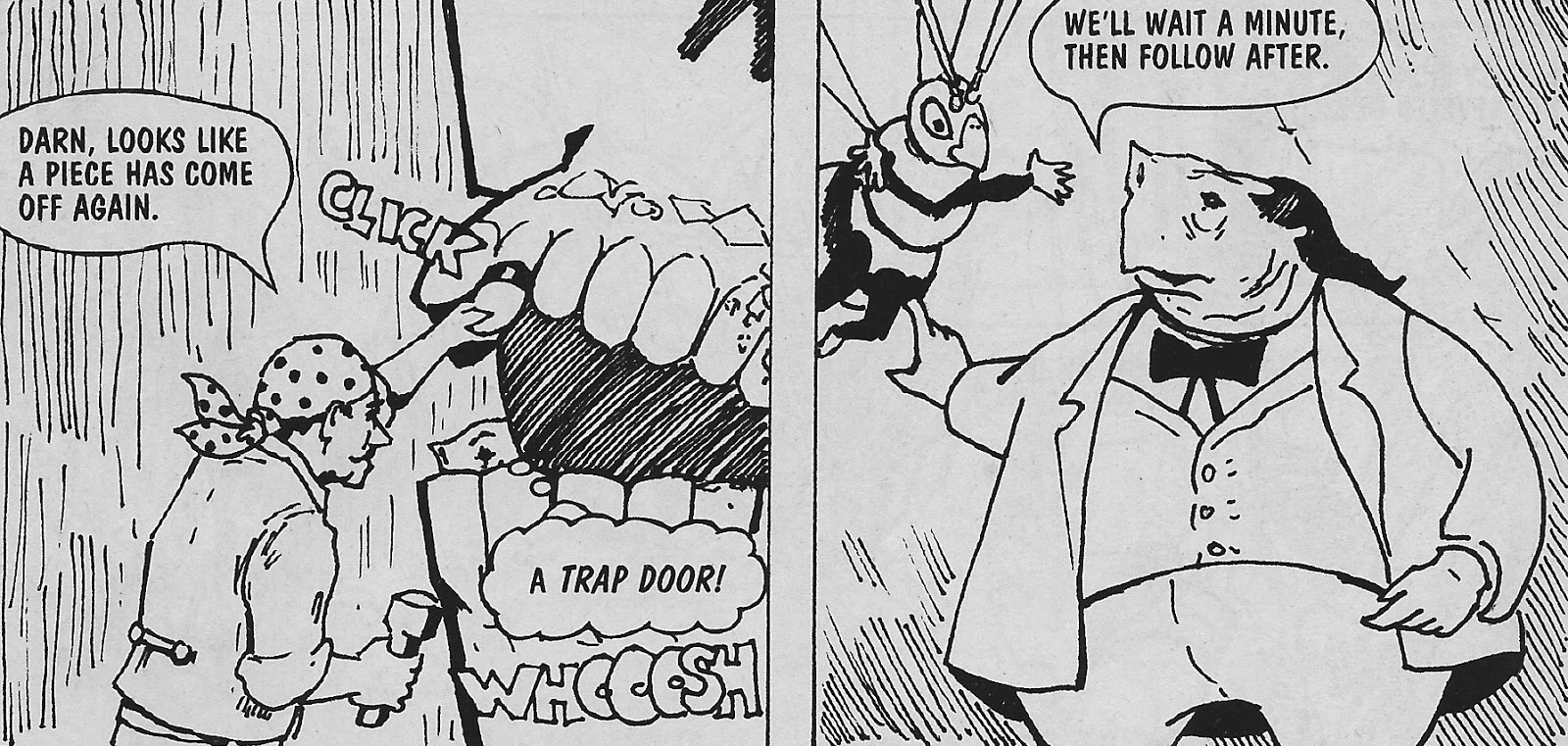
I do appreciate the way this story begins, because it wastes no time with introductions. For a kids' book especially, this feels unusual, so I give writer Phil van Steenburgh credit for diving right into his bizarre setting and cast. This is a period piece of sorts, except I'm not entirely clear what period it's aping. Modern technology doesn't exist, but there are things like planes and cars, so...less than 100 years ago, say. Also animals and humans interact as equals, which is more important than the era. As their names suggest, Buzz is a bumblebee, about the size of a dog but with human intelligence and speech. Colonel Toad is a man-sized and well-dressed toad, who I guess is also literally a current or former colonel in whatever military exists, though the details of his record are not divulged here*.
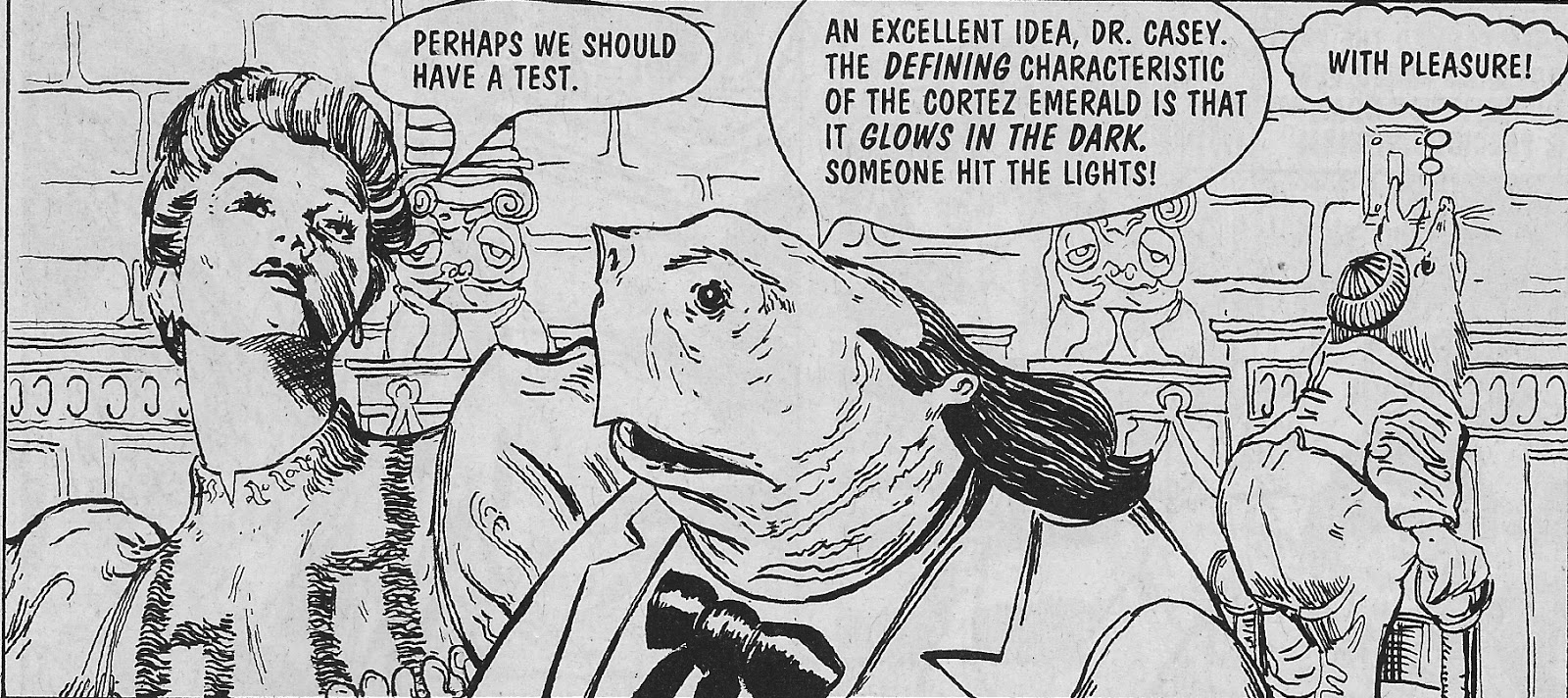
There's no time for that kind of backstory, because right on the opening page, Buzz is running late. He's headed to see Colonel Toad donate a one-of-a-kind emerald to the local museum, supposedly the last relic of the ancient Cortez culture. But before Toad can finish presenting his gift, two other citizens emerge from the crowd with their own Cortez emeralds. All three pass the glow-in-the-dark test, which should be impossible, and Toad thinks the whole affair seems suspicious. Without missing a beat, he and Buzz leap into a plane and fly off to the island where the Cortez lived before the earthquake that supposedly ended their civilization. Once they arrive, the heroes are greeted by a manic tour guide/restaurant owner who hurriedly shuffles them to a few unimpressive sights before forcing them to eat bad sandwiches.
That tour guide is the story's villain, Gigi the Gypsy. It's pretty offensive, there's no doubt, that the bad guy is a gypsy dealing in illegal emeralds, and that's not the only culturally insensitive part of the story. Gigi's crime is based on the discovery that the Cortez were still alive and thriving in a hidden underground valley. They've also continued to mine emeralds all this time, so when Gigi finds them, he uses modern drugs to position himself as medicine man and therefore be in charge. He then abuses his power to sell the emeralds back home, until Buzz and Toad show up and foil his plot. Gigi is definitely exploiting the Cortez and should be stopped, but one of the things Toad most strongly objects to is that the Cortez were denied a chance to interact with modern culture. This doesn't sit very well with me the way it's presented, with a very stark and inconsiderate sense of right and wrong. Nobody asks if integrating the Cortez is actually what's best for anyone, or what they themselves want. Their first contact was with Gigi, and it led to them being lied to and taken advantage of. Why is it necessarily a good idea to move further in that direction, as opposed to allowing them to continue as they were, or even protecting them somehow? Maybe there are sound reasons, this is after all a totally fictional reality of which I've only seen the tiniest fraction, but it would've been nice if they were included, or just if the discussion took place. 

There is dialogue at the end of the issue, from Toad's friend Oogles (a fancy worm, see below), stating that the Cortez are getting help adjusting to the world and that they gave Toad an emerald to thank him for what he'd done, so all's well that end's well, I guess. But there's still a gypsy antagonist for no reason other than "gypsy" being inappropriate shorthand for "untrustworthy", and an uncomfortably imperialist tone to the whole narrative.
It's also a story that moves too quickly for its own good. Any new information is stated out loud by the characters, sometimes necessary because the art's unclear, but more often I think van Steenburgh uses the young age of his target audience as an excuse to write a bit lazily. This leads to regular info dumps and moments of handwaving dialogue, corner-cutting that muddles the story in the name of moving more quickly onto the next beat. It also dampens the attempts at humor; this isn't as lighthearted an adventure as I think the creators believe it to be, and the jokes fizzle. 
The only section that's slightly funny is the back-up feature starring Oogles. We learn that he's a professional shrew-drawn carriage driver, and I think it's amusing that in a world where giant worms wear top hats and smoke pipes (and have arms, for whatever reason) there would also be big shrews that are basically just horses. What is the logic behind that? To make it even more ridiculous, Oogles later tries to hire chipmunks to replace his shrews, even though the chipmunks can talk and stand up just like he can, so...what is the distinguishing line between which animals behave like humans and which do not? Buzz is somewhere in between, too, by which I really just mean he isn't wearing clothes.

In Oogles' story, he wants to find something to drive other than shrews, and tries a number of different methods of transportation that all fail miserably. Just as rushed as the main story, the back-up actually benefits from the pace, because the rapid-fire succession of Oogles' mistakes is much of what makes them amusing. In the end, he learns (and says) that the grass is always greener on the other side, and decides to return to his shrews. Which, since they're basically pets and therefore a responsibility to which he's already committed himself, is the best lesson for children to learn in this whole comicbook.
The art is by Alan Howell, and it's just as uneven as the writing. It can be very sparse and sketchy, and even the most detailed panels aren't especially full. And it looks like some panels are partially traced from each other, with most of the characters and set pieces in exactly the same position save for one or two minor shifts. This and the not-infrequent blank white backgrounds indicate a lack of effort similar to what's evident in some of the script, deadening the entire work. 

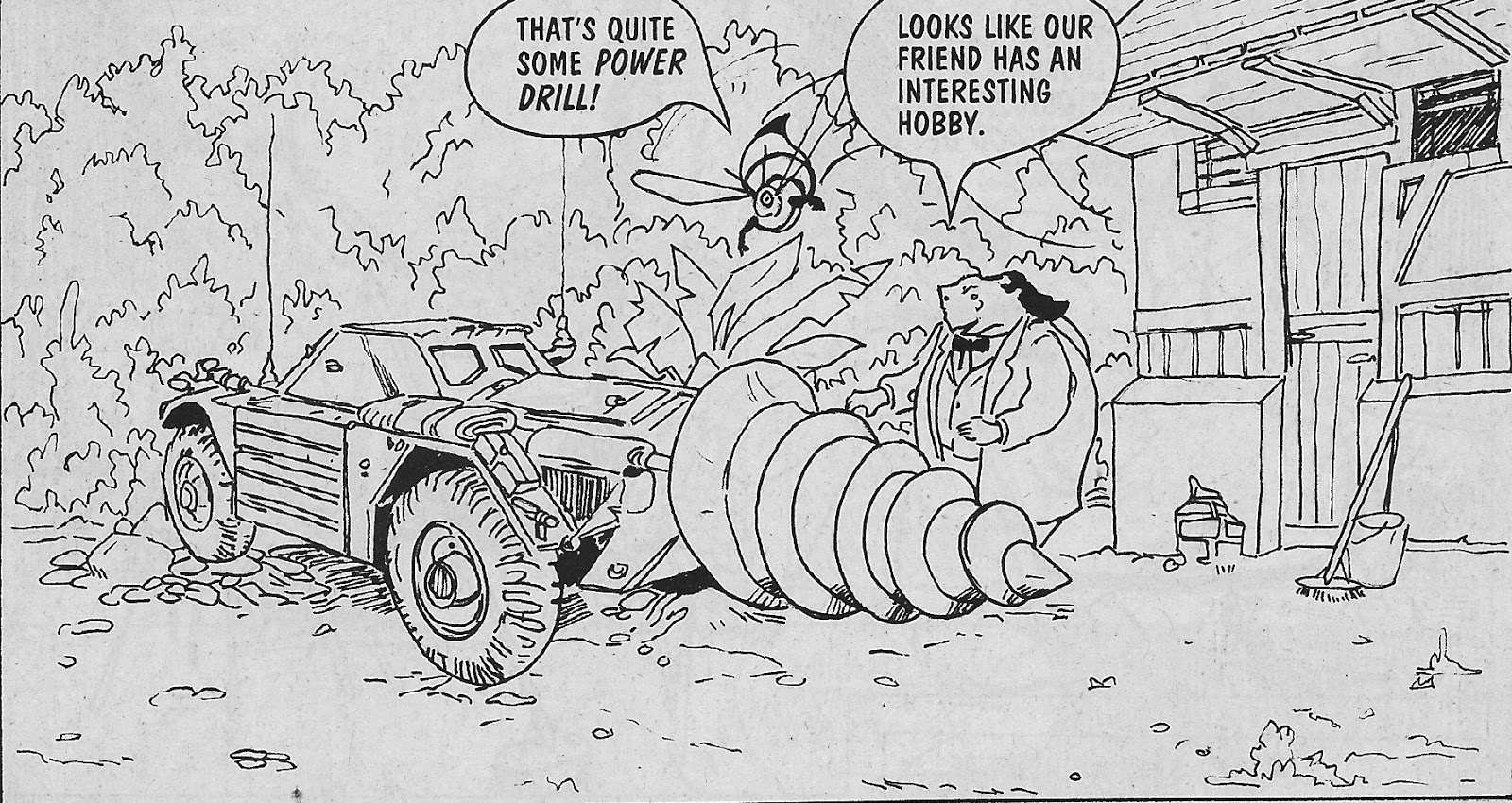
So Buzz and Colonel Toad #1 is not a winner, perhaps not worth the quarter I paid for it. I do, however, have one sprinkle of praise to toss out here at the end for Howell's work: I actually laughed when I saw Gigi's giant drill vehicle. It's a dumb plot point, since it never gets used and it's a clichéd visual that doesn't fit in this story whatsoever. But as an image, it's uniquely intricate, and thus an actual surprise, earning it's one panel and then some.
*The back cover does say that Toad's grandfather fought in the Great Swamp Wars. The most intriguing tidbit of the entire issue, I'd say. 

Thursday, May 23, 2013

This Exists!: Captain Awareness: Assault on Campus


This Exists! is a semi-regular column about particularly strange, ridiculous, and/or obscure comicbooks I happen to have stumbled across.

I can't remember exactly where it was that I found Captain Awareness: Assault on Campus, but I know from the sticker on the cover of my copy that it only cost me 25 cents. It must have been years ago, since I'm sure I read it back when I first picked it up---otherwise it wouldn't be stored in a longbox but instead sitting in one of many growing  piles of unread comics---but I have zero recollection of that initial reading experience. My assumption is that I bought the issue simply because it was cheap and looked sort of goofy, whizzed through it without much thought back in the day, and then stashed it away and forgot about it until it caught my attention recently while I was mining my collection for something new to write about.
Rereading Captain Awareness for this column, I was unexpectedly impressed with a lot of the material, which was thoughtful and honest in its dealings with the incredibly sensitive subjects of rape and sexual assault on college campuses. That it chooses to discuss these problems in the context of a superhero comic is arguably a bad call, not because superheroes can't deal with such serious things (they can and have), but because writer/artist D. DeAngelo's superhero work isn't nearly as deep or detailed as his handling of rape. Captain Awareness is an interesting concept, and a nice if obvious metaphor, but ultimately as a character it's a ham-fisted stock superhero persona, which is always hard to take entirely seriously. Therefore, the potential exists for the title character of this story to actually detract from its message by making it seem sillier than it is. But I do think DeAngelo avoids making that mistake as much as possible here, so in the end this is a successful effort.
Make no mistake, it's an after school special. I can't pretend that DeAngelo's dialogue is anything less than forced and unnatural, with characters shooting sexual assault statistics at one another and everyone, even the villains, openly discussing their feelings and points of view in no uncertain terms. The main bad guy, Rick, is as bad as they come, a bully and serial rapist with a pseudo-mullet who feels no remorse and flaunts his conquests to everyone. There are no real layers to his or any character, because everyone has a single role to play to the max: the horny asshole, the respectful good guy, the damaged victim, the concerned friend, and Captain Awareness as the do-gooder who's just as pure as Rick is wicked. DeAngelo isn't going for subtlety or even realism, because this comic is trying first and foremost to be comprehensive, then accurate, and only at the bottom of the priority list is being a great piece of fiction. If it has to sacrifice nuanced storytelling so all of its points can be made clearly, it does so, and where I might usually take issue with that tactic, in this case I think it works.
     In the space of only 36 pages, if your aim is to examine the innumerable causes and consequences of rape on America's campuses, you're going to have to trim the fat and get right down to it. That's what DeAngelo does, by having his characters speak plainly and directly about the topics at hand. It allows the reader to see things from many different angles, and get a fuller picture of all the ways rape can affect someone's life. It's not just Diane, Rick's most recent victim and the comic's narrator, whose life is dramatically and forever changed. Her roommate, Denise, is also deeply affected by the events, as are Denise's boyfriend Mike, new student Maria, and Rick's ex-girlfriend and previous victim Helen. That's a decent number of brand new characters to move through, and even if they aren't entirely three-dimensional, they at least have distinct attitudes about and reactions to the incidents of the story. Between them, they cover a lot of ground, so DeAngelo can discuss not only the mindset of rapist and victim, but those of the people around them, too, good, bad, and ugly.
I can also understand the impulse to lay everything out overtly in a story like this, if for no other reason than to avoid any chance of misinterpretation. Not that DeAngelo was worried his comic would come across as pro rape, but if what Captain Awareness wants most is to give a voice to the victims, and that certainly seems to be its primary goal, then it's absolutely essential to have that voice be loud and clear. Which is what we get in Diane, a straightforward and emotionally raw expression of the shame, fear, anger, disgust, self-doubt, and other miseries being sexually violated can (and does) bring about. Her narration is bold and brutally forthcoming, and certainly the aspect of the writing which DeAngelo gives the most attention. Running throughout the issue, Diane's description of what was done to her and how it made her feel, and continues to make her feel, is the true heart of this book. She is very much the star of this story, and its biggest creative strength as well.
Really quickly, I should probably talk about Captain Awareness itself (not himself or herself, see below), because it's the title of the damn book and also a genuinely interesting idea. The concept behind Captain Awareness is that, rather than being a single individual, it is a set of powers---strength, invulnerability, flight, and "cosmic awareness"---that can be granted to literally anyone when they need it. In this issue alone, Mike, Denise, and two different unnamed character all get a turn in the costume, each contributing to the fight against Rick's widespread damage in their own way. That's a neat idea, and not one I can remember seeing before, although it's the kind of thing I have to assume someone else has done somewhere else at least one other time. Regardless, DeAngelo introduces the mechanics of Captain Awareness on the first page, and from there lets the character speak for itself. And there is a definite, unique voice for Captain Awareness, no matter who specifically is playing the part at any given moment, which, again, is something I rather like. Captain Awareness is a single entity with infinite possible bodies and minds, the opposite of a secret identity, basically. Everyone knows about it and what it stands for, and they all seem to be in on the fact that anyone can become Captain Awareness at any time. That's a bizarre and original relationship for the public to have with a superhero, and though it is not at all the point of this comicbook, it's an idea worth applauding.
     The artwork is also noteworthy, though not necessarily for DeAngelo's pencils, which are serviceable but never amazing. What is pretty amazing is the line-up of inkers: George Perez, Gordon Purcell, Norm Breyfogle, Dick Giordano, and Jimmy Palmiotti, among others. Each of these recognizable and respctable industry professionals handles only a few pages worth of inking duties, but they all help to solidify DeAngelo's work and message. There are also some pin-ups in the back of the issue by the likes of Colleen Doran, Dan Jurgens, Trina Robbins, and Mike Wieringo, as well as Purcell and Breyfogle again, plus a cover by Phil Jimenez. And they're all nice additions to the Captain Awareness tapestry. Except, I guess, the first pin-up, by Alex Ross and Brent Anderson, which for some wholly inexplicable reason is of Winged Victory from Astro City. I mean, cool character to throw in there, and thematically related inasmuch as Winged Victory's whole deal is female empowerment, but still a weird choice.
Colleen Doran delivers my favorite pin-up
Captain Awareness: Assault on Campus is hokey and often awkwardly scripted, but done with such earnestness and care that it still manages to be a success. It tackles its subject matter with very little reservation, opting for wholehearted honesty rather than emotional subtlety and subtext, using a spotlight instead of a flashlight. This doesn't make for an exceptional superhero comicbook, but it's a damn fine attempt at discussing a serious and widespread problem, as relevant today as it was in 1998 when this was first published. If you can't take my word for, "Comics With Problems" has the whole issue available online for free (really starts on page 4). They seem to be poking fun at it, which I think is in poor taste, and I'm not entirely certain that reprinting it digitally like that is even legal, but it's there nonetheless. And if you're interested, there also exists the official Captain Awareness website, which appears to be way out of date, but has some interesting background bits and pieces as well as a discussion of plans to change the character's name to Major Impact. Not sure if that ever really happened, but the idea made me smile.
     Did DeAngelo ever do anything concrete with Captain Awareness beyond this one issue? I don't know, and it doesn't really matter. The issue itself is a complete narrative, and an ambitious stab at dealing with taboo but important content. Not the greatest of creative triumphs, and not even the most effective, I don't think, strategy to employ in the fight against college sexual assault. Yet still a worthwhile and in many ways impressive effort from all involved, DeAngelo especially, since it is his pet project. He clearly put a lot of himself and those close to him into this book, and his bottomless concern and care comes through on every page.

Monday, February 18, 2013

This Exists!: The Great Grimmax #0 & Splatterball

This Exists! is a semi-regular column about particularly strange, ridiculous, and/or obscure comicbooks I happen to have stumbled across. 

One of my continuing comicbook collector missions is to acquire everything Defiant Comics ever published. It's not that vast a library, since the company only existed for about two years, but they're somewhat elusive books. Defiant was founded by Jim Shooter after he had already been ousted as editor-in-chief of both Marvel and Valiant. It appears to have been sort of a vanity project for him, with his name being attached to nearly every project as at least creator and editor if not writer as well. And though they don't tend to be comics of the highest quality, I find them uniquely interesting and would love to someday own them all. They tend to have some genuinely good ideas, but with storytelling that's half-hearted, obvious, and/or absurd, so the results are often unintentionally amusing. I like that, and I want more of it in my life.
     My introduction to the accidentally-funny world of Defiant was Splatterball, which I picked up and skimmed at a sale just because of its cover. It was only twelve pages long and seemed colorful and strange, so I figured it couldn't be that bad, and it was cheap enough that I ended up buying it.
Then I read it, and it was awful. But fun awful, the kind of lighthearted, marshmallow-level material that doesn't take itself seriously enough to even be worth ridicule. It's empty calories, primarily a means of introducing readers to a few aspects of PLASM, the planet that was meant to be a major setting in the greater Defiant continuity. The plot is flimsy, because it wants to be character-based, yet all the characters are two-dimensional (at best) and mostly unlikable. But the comic doesn't even seem to be trying for a decent plot. The whole thing is an ad for other comics, a giant finger pointing out a few almost-interesting elements of PLASM. See? The sports on this planet are brutal! or FYI, the government is super corrupt. It's not even numbered as Splatterball #1 because there was never any intention of publishing a second issue. It's promotional material, basically, but I didn't pick up on that until I'd finished reading it.
What there is of a story centers on the championship game of Splatterball, an event that means a lot of violence on the field and gambling on the sidelines. Various forces of evil try to rig the game and control its outcome for their own greedy intentions, but star athlete The Great Grimmax is skilled enough to squelch those plans and claim victory in the end. A shallow victory, though, because it means the death of his entire team and the one they were playing against. Grimmax, the only survivor, is also the only player who ever seems disturbed by the murderous nature of the game, but he still plays to win.
     Lucky for him, in his own book, The Great Grimmax  #0, he has escaped PLASM and is living on Earth as an earnest and naive bicycle delivery boy. Ostensibly this zero issue was intended to introduce the character so that a series could then launch in which he was the star, but according to the Internet, no such series ever existed. It's not hard to see why, because he's a bit robotic for a leading man. His lack of understanding of human behavior is so extreme, it makes it hard to believe that he'd even have a delivery job. And while his dialogue represents total honesty and kindness, he's pretty quick to start throwing punches when cornered. That's too many incongruous details for an eight-page character introduction, and certainly doesn't make me want to read more.
So Grimmax's first and only solo adventure was that of delivering grapefruits to a rough part of the Bronx, and inadvertently teaching one of the local street hooligans a valuable lesson about the importance of life. It is the after school special of sci-fi superhero stories, complete with forced dialogue and a hamfisted delivery of the ultimate message.
But again, as bad as this is, it's a kind of bad that makes me happy. I chuckle at almost every line Grimmax has, not in spite but because of how unrealistic it all sounds. When you pass a certain threshold of awful, you reach a zone of comedy, and both of these books sit there comfortably.
     So I started snatching up other Defiant titles after reading these, not expecting quality material but still hoping for enjoyable experiences. Some of what I've found has been better, and some of it has been even worse, but it all hits that sweet combination of decent concepts and poor execution that makes for fun, funny, easy reading. Sometimes you gotta wade through the muck so that the oasis seems even sweeter. Splatterball and The Great Grimmax #0 both remind me what junk comicbooks look like, so I can more fully appreciate the great ones that share my longbox space with these weaker issues.

Thursday, January 10, 2013

This Exists!: The Collective

This Exists! is a semi-regular column about particularly strange, ridiculous, and/or obscure comicbooks I happen to have stumbled across. 

I briefly met Ben Bishop a few years ago at my first and only (to date) Boston Comic Con. At the time, he was primarily promoting his recently-completed graphic novel, Nathan the Caveman, which didn't interest me. One of my roommates did buy a copy, and it ended up being significantly better than expected, but I was more immediately drawn to the other, much smaller self-published project Bishop had brought with him: The Collective. A half-sized comicbook with three chapters, each written and drawn by a different creator in an attempt to tell an unplanned, collaborative story.

Bishop also signed my copy. Thanks!

Now, The Collective is a failure in several ways, and it certainly doesn't live up to the promise or potential of its concept, but when I reread it in preparation for this column I found it much less disappointing than I remembered. It's a big swing, or a series of big swings, and far better to fall short on a bold move than succeed at something safer.
     Bishop, who cooked up this project, also contributes the opening, and it is easily the strongest section. Despite the idea being that the various creators are telling a singular story, each chapter reads like the beginning of a different comic, and Bishop's is the only one that makes me want to pick up a hypothetical second issue. A young guy wakes up in the back seat of a taxi being driven by silent men in featureless masks, and he has no memory of how he got there or what's going on. Bishop utilizes the smallness of the setting and of the comicbook itself with tight, rigid, claustrophobic panels.


These pages are not consecutive

None of his pages have fewer than seven panels (until the final splash page), but he never sacrifices clarity or detail, and his script is just as carefully and skillfully crafted. The protagonist is relatable and efficiently introduced, his internal monologue full of dry humor and confused fear in light of the extraordinary circumstances in which he finds himself. And as the details of those circumstances are slowly revealed, the mystery of the story deepens and widens, racing us toward the powerful and intriguing cliffhanger on Bishop's last page.


These, on the other hand, are totally consecutive

So "The Crash and the Crowd" (the title of Bishop's initial chapter) is a triumph, and one hell of a gift to Joel Rivers, the man tasked with creating the next piece of this comicbook puzzle. Bishop establishes a strong leading man thrown into the midst of a tantalizing and surreal mystery narrative, and all Rivers needed to do was run with that baton. Alas, he chooses instead to change the tone, storytelling methods, visual style, and genre, resulting in a jarring and far less enjoyable second beat.

See? It's a whole new world

If taken out of context, Rivers' chapter ("Beyond Belief") isn't actually all that bad. There's still some solid humor, an intentionally unfinished art style that adds to the overall sense of chaos and terror, and the final two pages, despite being the furthest diversion from what Bishop built, are exciting and enticing on their own. But we also lose the narrator's voice entirely, and the subtle and silent masked men become loudly-buzzing insect monsters, so it's a pretty disjointed attempt at continuing the story which precedes it. An ambitious failure, bold in how brazenly it casts off much of what came before, but also ultimately a flub for the same reason.

That lightning guy with the sword will never be seen again

Which brings us the the conclusion of the actual comicbook I acquired in Boston---but not of the project, more on that below---a near-silent, six-page "addendum" titled "Some Time Ago" by Jason Gorcoff. Though it features the masked men and at least the name (possibly also the person) of the woman from Bishop's story, there is no narrative to it whatsoever. It's beautiful, a little sad, and strangely powerful, but it does not extend the story, only underlines the themes of confusion and a lack of control.


Also not consecutive, but it makes little difference here
I did a bit of digging and found this, which includes a fourth chapter by Ryan LaMunyon that's the closest in tone to what Bishop lays out at the start. I think Bishop followed by LaMunyon makes for a pretty stellar first two chapters of a story, especially a story-by-commitee, though to LaMunyon's credit he also pulls a lot of stuff directly from Rivers' chapter, and even Gorcoff's. It's a shame that Lamunyon's work wasn't included in the initial printing, because it's a far stronger landing than what I got at first.
     And what became of this theoretically ongoing effort to make a collaborative comicbook? I was unable to find out online, but I assume that, as many homegrown artistic projects go, there was trouble raising further interest or commitment from new artists and so the whole thing petered out. I'd prefer to be wrong, that four years later there's still a tradition amongst Portland comic creators to contribute a chapter to this now-sprawling epic. There's an article reprinted in the back of the issue that even names a few other artists who have supposedly signed on, including Ben Asselin, who had already agreed to be the one to write the ending. Did Asselin ever actually produce any work for this title? And if so, where is it?
     I'd like to know because I want to see things like this succeed. Not just independent comicbooks, but experimental ones, cooperative ones, and ones that don't sacrifice the quality of the art or writing just because they have a lower budget. And it needs to be said that all four of the creators involved delivered quite solid work on both fronts, even if there wasn't a lot of cohesion to the final product.

Saturday, November 24, 2012

This Exists!: Soul Bound

This Exists! is a semi-regular column about particularly strange, ridiculous, and/or obscure comicbooks I happen to have stumbled across. 

Before I moved to Austin, me and the two guys with whom I was planning on moving came down to visit the city and see if it was really where we wanted to live. One of the most important and enjoyable parts of that visit was printing out a list of all the local comicbook stores (there's an impressive amount of them here) and visiting each of them to see what they offered and how they differed. Mostly, the only significant difference was the size of the building. In terms of current comics, almost everywhere we went had the same (very good) selection, and they pretty much all had sizable back issue sections as well. However, somewhere right in the middle of this tour of Austin shops there was a place that had a single, sparsely covered shelf right by the exit with locally-produced comicbooks. I wish so much that I had paid closer attention to which store it was, because in the three-plus years I've lived here I have never again found that local comics shelf, and the longer I go without seeing it the more I suspect that, wherever it was, it has since been removed. Regardless, it seemed silly to come to a city for the sole purpose of feeling it out as a place to live, be offered comicbooks created and published locally, and not go home with them, so I picked up a copy of each of the two series that sat so alone on this particular shelf. One of them was a strange western I can't remember the exact title of, which I read once that day and never returned to. The other, though ultimately not significantly better than the western, was an unexpectedly interesting and enjoyable comic called Soul Bound #1.
I'm not even entirely certain what the book is about. There is a family of what seem to be gods, two parents and their countless children, who I guess interact with the normal people of the world with some regularity. They are also trying to destroy "the blade," which they sometimes refer to as an "elios," but neither of these things are explained in any detail. What the blade is and why it needs to be destroyed remains a mystery, and so do the exact powers of these apparent deities, as well as their goals and backgrounds. Indeed, we get only the sketchiest and most basic bits of world building in Soul Bound #1. For example, each of the children gods are told to choose their avatars, and there is some mention of these avatars having powers of their own, but what they can actually do, what purpose they serve, and why they're needed at all never comes to light. The most we learn is that avatars are selected from dead humans, which is shown to us in the final four pages and acts as a sort of half-assed semi-cliffhanger for this debut issue (which I believe, based on what I can find online, was the only issue ever produced).
So there's not a lot of information provided, or even that much characterization. We learn that the young gods, or at least two of them, are pretty typical petulant children, disobeying their parents with dire consequences and then desperately hurling excuses for their behavior to avoid blame. The parents, meanwhile, are similarly archetypal, delivering threats of taking away their children's powers and/or turning them into mortals much the same way a real-world parent might cut off a child from TV for a week. It's not a bad relationship between parents and kids, it's just not all that fresh or original, especially with the dialogue never quite feeling genuine.
All of this kind of weak, vague material, though, is in the latter half of the comic. The opening sequence is a near-silent 15 pages, and it is this fast-paced beginning that really captured my attention when I first read Sould Bound #1, and it's the reason I've ever bothered to revisit it since then. We follow two of the young gods as they battle each other mid-air, tearing through a village full of normal humans and leaving utter destruction and widespread death in their wake. As their fight progresses, the book takes several pauses to turn away from the combatants and zoom in on the everyday people whose world is being devastated because of these immature immortals. And there is just something that has always appealed to me about this kind of story, examining the realistic and terrifying consequences of a world where superpowered beings can and do directly affect the lives of regular people. There is a large part of me that actually wishes Soul Bound #1 was just that and nothing more, that the entire issue was one long fight between these kid gods with breakaway moments where we see the consequences and immense collateral damages caused by their foolish brawl. As soon as the fight is stopped and the real plot of the book begins, things become a bit dull and confusing and slow, but those first 15 pages (and particularly the initial six pages without any dialogue whatsoever) are a fun if simple way to look at a concept I've always found interesting.
Of course, there are plenty of bigger-name, better-produced comicbooks that have explored these ideas, be it superheroes or gods or something in between messing up the lives of the non-powered masses, but even if it is somewhat familiar, I appreciate the approach of Soul Bound #1. It dives head first into the chaos and destruction without any kind of lead-in or introduction, which makes it all feel more immediate and urgent and real. If this was the kind of thing that actually occurred in our world, I imagine this suddenness and lack of warning would be a very big, very scary part of it. So throwing the reader into the thick of things helps us to empathize with the victims of this immortal boxing match, even if we don't yet know the hows, whys, and wheres of what we're reading. It's a shame that things slow so significantly from there and never pick back up, because I'd like to love this comicbook from the city I call home, and instead all I can manage is to feel a lackluster appreciation for having found it at all.

SIDE NOTE: Neither the website for the publisher, Electric Chinchilla Comics, nor the printer, Dark Phoenix Printing, seem to be active anymore. Also, the 800 number listed for Dark Phoenix on the back cover now belongs to something called National Annuity and Life Sales. I do recommend calling it after hours though, when the message says only, "Thank you for calling for free information." Free information? That's worth its weight in gold!

Tuesday, July 24, 2012

This Exists!: Carbon Knight

This Exists! is a semi-regular column about particularly strange, ridiculous, and/or obscure comicbooks I happen to have stumbled across. 

Carbon Knight was published by Lunar Studios, an independent company from Elysburg, PA that I can only assume was formed for the sole purpose of producing this book. Elysburg's biggest claim to fame is an amusement park that anyone who isn't from the region has never heard of and can't pronounce: Knobels. (No, the K is not silent). The story of Carbon Knight is set in the even-smaller Centralia, PA, and literally the only thing you need to know about that place is that it's had an unstoppable underground coal fire burning beneath it since the 60's. What I'm getting at is that this series is pretty Pennsylvania-centric, and I only even know about it because I happen to be from the area, and when I was young enough to be impressed by anyone at all who made comicbooks, I got to go to a tiny local convention and meet the creators and get signed copies of all three (at that time) issues. Something like a year later they put out a fourth and final oversized chapter, but I never tracked it down, because by then I took my comics slightly more seriously.
      And Carbon Knight is not to be taken at all seriously. Even as a child I managed to suss that out. Bulky 90's art, unnatural dialogue, illogical plot beats, and uninteresting ideas pile on top of each other to create a less-than-impressive whole. Throw in the locally-based historical fiction aspect of the story, and the undoubtedly low-volume printing and limited distribution considering the publisher, and the fact that the title had four whole issues and got to do a proper finale becomes sort of impressive. The creators clearly wanted it to be an ongoing series (see below), but ended up with a mini-series, which, I guess, is something. It's a shame, though, that I never sought a copy of issue #4, if only because now, more than fifteen years later, I am able to appreciate the series for the earnest if amateurish effort it was, and I genuinely wish I knew how the narrative wrapped up. I can pretty much guess, though, because it's a dry, simple, predictable story.


Fire Chief Kyle McKnight---who, if you couldn't tell from his last name, is the man who eventually becomes Carbon Knight---is maybe the most extreme version of the noble boyscout character I've ever seen. He will sacrifice life and limb to do the right thing and/or save another, he's a loving and capable husband and father, and he stands up to corruption and foul play wherever he finds it. And this is all before he becomes a superhero. 
Chris Ring, who writes and draws the entire first issue himself, does this kind of broad character work with everyone, and the addition of his (I assume) brother Brendan Ring to the creative team in Carbon Knight #2 doesn't ever add any notable depth to the cast. They are largely archetypal characters who say whatever they are thinking out loud in the plainest possible language, even if it means pointing out something weak about the plot.


And it is a flimsy plot at best. After McKnight's mysterious, clichéd supernatural accident while trying to stop the Centralia fire, he is transformed into a being with skin like coal, super strength, and, inexplicably, flight abilities which involve his legs creating fire. He then sleeps for thirty years, buried in a collapsed coal mine, until he is finally awoken and, through a string of ridiculous coincidences, ends up rescuing his now-grown police officer son Daniel from the same corrupt politician who had a hand in McKnight's original accident. The coincidences include things like McKnight deciding that, even though he knows it's not a good call, he'd rather take a late-night flight to clear his head than work with a scientific genius to figure out what the hell has happened to him.


While out, he's lucky enough to arrive at his son's capture just in time, which also happens to occur on that same night for no particular reason. This sort of happy accident isn't uncommon in even major superhero books, but in Carbon Knight it's kind of all there is. McKnight's grandchildren and daughter also wind up involved in the adventure in their own ways, all through dumb luck. And always, more than anything, through the most unnatural, expositional of dialogue.


Chris and Brendan were not shy about the long-term plans they had for the book. In the back of the very first issue, we get this never-explained teaser:


And Carbon Knight #3 has a whole sketchbook of "upcoming characters" who never got to have their stories told:


But while making plans for the future, the Rings never took the time to craft a sturdy opening arc, and so the only tale they ever got to tell ends up being a bust. There's no reason this character couldn't have been a fresh, locally-inspired take on superhero tropes. The foundational concepts for that kind of story are here. Yet instead of being original, Carbon Knight just feels irrelevant, too derivative of its predecessors in the medium and from too insignificant a company to ever have any hope of gaining a large enough following to keep it alive. Even as a ten- or eleven-year-old fledgling comicbook fan, not yet jaded by the industry or reading with anything resembling a critical eye, I wasn't excited enough by what I saw in these three issues to notice or care when a fourth was produced.
     Though here I am, more than fifteen years after first being underwhelmed by Carbon Knight, not just revisiting it but writing about it long-windedly. I wanted for it to be better than I remembered. I want to know what lessons the Ring boys learned from their failed attempt at self-starting a comics career, and if they're working in the medium in any way today. Even though I don't like the series, it interests me. Yes, a lot of that is its ties to my past and its connections to some of my earliest comic-related memories, but also...I admire the ambition if not the talent of the two young men who tried to write about their own characters in their own world on their own terms. They got ahead of themselves, it's true, making long-term promises they couldn't keep because they had not fully grasped the basics of solid storytelling. But they stuck their necks out and accomplished more than any number of similarly aspiring creators, and they made it into the formative reading years of at least one lifelong comicbook fan, so hey. Good on you, Chris and Brendan, wherever you are today.
     As a final thought, I've never seen worse hair in anything ever.