100 Bullets #31: Now we're talking. Kicking off a new arc, "The Counterfifth Detective," this issue is pure hard-boiled pulp noir gold. Main character Milo Garrett sounds like every classic P.I. rolled into one, and he looks tough as nails, too, with his crumpled suit, bandage-covered face, and the cigarette that's pretty much always hanging out of his mouth. Both Brian Azzarello and Eduardo Risso do a good job of keeping this story right in the sweet spot, not over-the-top with the clichés but still very much utilizing the tropes of the genre. Milo is both likable and a schmuck; there's drinking, murder, intrigue, and plenty of stylized, metaphor-and-similie-filled narration. It's all quite familiar, but fresh enough to pull the reader in, and the added detail of Agent Graves giving Milo one of the attaché cases that he's been handing out since this series began makes things that much more interesting. There's not a ton of narrative meat on the bones so far, because this first chapter is more about introducing Milo and getting us in his corner. In that, it's a major success, and there's enough of a story hook at the very end to bring people back for more. This is the sort of finely crafted issue that 100 Bullets was full of at first, but that's been missing for a while, so it ended up being a fabulous return to form that reignited my enthusiasm for this title.
Automatic Kafka #7: Automatic Kafka goes out to lunch with one of his old supervillain foes, Galaxia, a scientist who replaced his head with a tiny spiral galaxy. Kafka has a good deal of leftover animosity toward Galaxia, but the former bad guy is ever the gentleman, politely and intelligently talking Kafka into letting go of their shared past. They even manage to reminisce a little together, and though they don't exactly become friends, they pretty much bury the hatchet before their meal is over. It's impressive how Joe Casey manages to write their conversation so that the reader can be genuinely invested in them working things out, even though we haven't ever seen any of their previous conflicts, since they all took place in an off-panel time period. The hero-villain dynamic is so universally accessible, Casey can do something like this even in a brand new continuity and it still works. It helps that both Kafka and Galaxia have such strong voices, of course, and that they each have such fascinating looks. Even their speech bubbles are different colors, not just from one another but from everybody else, so their exchange offers something on every level, from script to art to letters. This was not the most exciting issue of Automatic Kafka, but it was one of the most thoughtful examinations of what life might be like for a retired superhero like Kafka, and it had a lot of heart and humor along the way. Also, in the end, the Warning uses Galaxia to power up a bunch of the baby bombs that have been an ongoing thread in this book, which was a nice way to conclude this, tying an otherwise isolated chapter into what's come before.
The Maximortal #1: I just wrote about this issue a couple weeks ago as part of a PopMatters column on three of my favorite debut issues. And in the early days of this blog, a did a short post on the whole of this series. But I wanted to do it for Monthly Dose because its a dense book, and every issue sort of touches on a different aspect of the Superman mythology and/or history, deconstructing that character, superheroes as an idea, and the comicbook industry as a whole. It's an ambitious, weird, well-done passion project from Rick Veitch. This first issue doesn't actually set up that much of what's to come, focusing instead of doing Veitch's version of the Superman (or True-Man, as he's called in this comic) origin story. A couple named the Winstons finds a baby boy inside a bizarre fallen meteorite, and they try to raise him as their own, but his superpowers make him well more than they can handle. The child destroys their house with his strength and heat vision, bites of his adopted father's finger, and in the end he uses the threat of further violence to get his dad to carry him away from the farm and into an unknown future. It's a much more brutal, darkly comedic take on this well-known superhero story, casting Superman as something of a menace, but only because he's too young to know or even want to use his abilities responsibly. He's just a kid throwing superpowered tantrums that his simpleton parents have no way of controlling, so he ruins their lives and takes over. The events of the story are pretty tragic, but Veitch's art and the exaggerated, caricature-like personalities of the Winstons make it work as parody, too, so we get both a funnier and a much bleaker version of Superman at once. That's the mission statement of The Maximortal, and it couldn't be clearer here.
Sunday, May 31, 2015

Sunday, May 24, 2015
Elsewhere
It's been like a month since I did one of these posts but I always like to wait until I have ore than one thing to link to and it just took that long this time around. So 2 weeks ago I published a 1987 And All That post about Iron Man #219-221, a.k.a. the first story arc to feature classic villain the Ghost. He's a character I fell in love with only recently during Jeff Parker's Thunderbolts/Dark Avengers run, and even though the initial appearance of the Ghost is very different, there's a lot about him that has lasted over time, and his first storyline was an exceptional one. This week, another 1987 column went up, looking at Peter Parker, the Spectacular Spider-Man #122-130. I was not wild about them, but as you'll see in the comments, part of that may have been that I was simply starting too late in the series' history and/or stopping too soon. Finally, this past Monday I wrote about three awesome debut issues on PopMatters: The Maximortal #1, Deep Sleeper #1, and Rebel Blood #1. Super-attentive readers will note that I've written about the each of those series on their own at some point in the past on this blog.
Something I Failed to Mention
I literally got back to my house 2 hours ago from the wedding I mentioned in my last post, so you'll have to forgive me if I can't think of anything to put here right now. I guess I could've held off on this until I had something prepared, but I like to do the Elsewheres on Sundays, and I've got enough other stuff to do this week, comics-blog-related and not, that I figured I should just bang this out while I could.
Something I Failed to Mention
I literally got back to my house 2 hours ago from the wedding I mentioned in my last post, so you'll have to forgive me if I can't think of anything to put here right now. I guess I could've held off on this until I had something prepared, but I like to do the Elsewheres on Sundays, and I've got enough other stuff to do this week, comics-blog-related and not, that I figured I should just bang this out while I could.
Tuesday, May 19, 2015
Please Hold
I am exhausted today. I got two poor nights of sleep in a row, mostly because of my dogs deciding to wake me up in the middle of the night several times for various reasons, like needing to go out or wanting to snuggle me in strange, uncomfortable positions. I love them to death, but they can be super obnoxious when they want, and the past couple nights have been prime examples of that. My dogs are not the point of this, they're just part of why I'm so tired right now. Other factors include my wife being in the early days of her second trimester of pregnancy, and the on-again-off-again insomnia I've had for years.
Why am I talking about my tiredness? Because it's my main excuse for not having anything new on the blog this week. Between being wiped out and needing to get myself ready to go to a wedding in Florida over the weekend (we leave in the wee hours of Thursday morning) I've had neither time nor energy recently to do much in terms of comics writing lately. Also, I've got to get started ASAP on my next 1987 And All That column, because that's scheduled to go up on Thursday and, as I mentioned, I'll be on a plane to Florida then. So tonight I've got to get my notes in order, then tomorrow I'll write the actual review.
As such, there's not going to be anything on Comics Matter (other than this flimsy nonsense) until next week when I'm back from the wedding. I should be able to jump back into the Weekly Action Comics Weekly routine at that point, plus I've got a couple other pieces I've been meaning to write for ages that I need to get off my plate. Little things like a post about a particular issue of Harbinger and a review of a weird, old, sexist-in-ways-you-might-not-expect romance comic from the 70's I bought on a lark a while back. So there's stuff in the pipeline, and after this little mini vacation I'm hoping to finally put it all out in the world.
Anyhow, I'll be back in a week with real material. Until then, go read Injection #1. It's hard to tell how good the series is going to be yet, but the first issue has such tremendous potential it's almost frightening.
Why am I talking about my tiredness? Because it's my main excuse for not having anything new on the blog this week. Between being wiped out and needing to get myself ready to go to a wedding in Florida over the weekend (we leave in the wee hours of Thursday morning) I've had neither time nor energy recently to do much in terms of comics writing lately. Also, I've got to get started ASAP on my next 1987 And All That column, because that's scheduled to go up on Thursday and, as I mentioned, I'll be on a plane to Florida then. So tonight I've got to get my notes in order, then tomorrow I'll write the actual review.
As such, there's not going to be anything on Comics Matter (other than this flimsy nonsense) until next week when I'm back from the wedding. I should be able to jump back into the Weekly Action Comics Weekly routine at that point, plus I've got a couple other pieces I've been meaning to write for ages that I need to get off my plate. Little things like a post about a particular issue of Harbinger and a review of a weird, old, sexist-in-ways-you-might-not-expect romance comic from the 70's I bought on a lark a while back. So there's stuff in the pipeline, and after this little mini vacation I'm hoping to finally put it all out in the world.
Anyhow, I'll be back in a week with real material. Until then, go read Injection #1. It's hard to tell how good the series is going to be yet, but the first issue has such tremendous potential it's almost frightening.
Monday, May 11, 2015
Weekly Action Comics Weekly Review: Issue #623
In 1988-89, DC changed Action Comics from a monthly Superman-focused series to a weekly anthology, also changing its name to Action Comics Weekly. It lasted 42 issues before reverting to a monthly format. I am going to review all 42 of those issues, one per week (sort of) for 42 weeks. This is the twenty-third of those reviews.
 The cover image of this issue actually comes directly from a panel within it, which is a rare event for this book, if indeed it has ever happened before at all. Not the most exciting moment to pick, but I appreciated it nonetheless, especially after last issue's wholly disconnected cover.
 I feel very blah about Green Lantern in this book right now. I know this is primarily because I was just barely starting to get invested in Peter David's narrative when he rather suddenly got replaced by James Owsley, the writer who David replaced initially. Owsley is a great talent, and he does this character well, but even several weeks later, I'm still more curious about the Freak Show characters David left behind than the new alien war we are introduced to here. I'm also not wild about stories where the hero is pulled into someone else's conflict unexpectedly, forced to participate because they are needed rather than choosing to because they want to help or feel some kind of obligation. If the protagonist isn't especially committed to the central struggle of the narrative, why the hell should I be? On top of that, the thing where Green Lantern needs to get to his battery before the recharge clock runs out feels tired. I realize this is an old comic so maybe that wasn't as trite at the time, but reading it with modern eyes, it just seems like yet another one of those stories for this character, with nothing new added to it. Maybe this will pick up now that Lantern knows what's going on, but at this point, I'm not sure it matters. Unless we go back and get some resolution on the Freak Show, I may be perpetually uninterested in Green Lantern's adventures in this series.
 Though it moved somewhat jerkily, I enjoyed the Shazam story a whole lot. The idea of a superhero not just feeling guilty about causing the death of a criminal but actively working to make up for it is right up my alley, and it was a good way for me to get into a character with whom I've had minimal experience in the past. To be honest, when I saw that Shazam was going to be included in Action Comics Weekly, it seemed like a drag, not to mention redundant since Superman is involved every week. But right away, Roy and Dann Thomas found a hook that worked, and sold me on it in only seven pages. I also appreciated how Shazam actually spends most of his time as Billy Batson. I love a good secret identity, someone who can have a whole life of their own and can have stories center on them without the reader merely waiting for them to switch to the super-persona so the real fun can start. This story is just as meaty when Batson is on-page as when Shazam is, and it seems as though both will be key to what's to come, so that's a good sign. Are white supremacists the most fascinating foes? No, but they are at least easy to hate, and I do look forward to Shazam trying to pull someone out of their clutches. I'm this will involve some amount of deprogramming, and I'm curious to see how Batson/Shazam handles that.
 This Deadman story, which I didn't miss for one second last issue, returns with the dullest installment yet. It's almost pure exposition, Madame Waxahachie just explaining to Deadman the history of the Peckshaw twins. It seems like this information could've been provided while there was, say, some action taking place, but instead we just get and infodump via dialogue as Waxahachie and Deadman drive around looking for someone he can inhabit other than Clara. When they finally do find that someone, there's a scene of Clara understandably freaking out over being used more than once as the vessel of a dead guy. This ties into the one aspect of this story I cared about at all, which is the idea that Deadman may cause permanent psychological damage to the people he possesses. I hope that thread isn't abandoned as we dive deeper into the voodoo zombie junk, because it's a compelling conflict for Deadman to grapple, and I'd like to see it explored more completely and maybe even in some other contexts. I'm not holding my breath based on how unfocused Mike Baron's Deadman has been in Action Comics Weekly from the very beginning, but time will tell.

 I was not expecting the bad guys to be motivated by crazy faith-based beliefs in the same way Galt and his group are. I assumed the villains would be anti-Superman because of his morality, that they feared he'd get in the way of whatever corrupt capitalist schemes they were cooking up. But no, it turns out they think Superman is the legit anti-Christ, which was an interesting wrinkle to add. One side sees Superman as a savior, the other as a harbinger and bringer of doom, and all the meanwhile Superman himself only recently learned these two factions exist, and wants nothing to do with either of their beliefs. I'm eager to watch this all play out, to see how Superman handles not only the folks who view him as a messiah but also those on the other side. My guess is that he'll want to show both groups the error of their ways and the danger of their extremism, but whatever he does, it's bound to be interesting.
 Secret Six is a blast right now. It seems to have, at least for the time being, fully embraced the action side of its spy-action mix, and this week had some of the best material yet in that regard. Acrobatic gunfights and daring last-minute rescues involving multiple vehicles are perhaps cliché, but Frank Springer and Frank McLaughlin make it all hum and maintain the mood of high-octane excitement. The plot is still a bit muddy, and it isn't progressing all that quickly, but I don't mind one bit. I'm loving the adventure, and Martin Pasko is careful to add at least a tiny bit of relevant info every time. It's not always new for the reader, but at the very least we will see one or more characters discover something they didn't know before, so it's all forward movement, even when it's minor. Also, "Standard Allowable Abductions" is very much my kind of title, appropriate and descriptive while also silly and fun just like the story that follows.
 I like the done-in-one Phantom Stranger tales that pop up in Action Comics Weekly every so often, and I absolutely love José Luis García-López as an artist, but this particular story underwhelmed me. For one thing, it tried to have a stick-tight-to-your-faith-and-all-will-be-well message, which isn't necessarily something I support. If you have faith, great, but faith should be flexible and reasonable and something that adapts to circumstance. Whatever...even if I agreed with the story philosophically, it fails to deliver its message convincingly anyway. The devil shows up at a church in the form of a baby, he and the Stranger struggle for a while, then the priest of the church smashes the baby to death with a giant cross. A cross may be a symbol of faith, but it is not faith itself, so the real takeaway here is that violence can solve problems better than simple, passive belief. Also, it makes me wonder why the Stranger had such a hard time in the fight if all it took to win was anything big and heavy enough to crush an infant. The imagery of the terrifying, sadistic baby was effectively creepy, and that was where García-López shined as he always does, but it wasn't nearly enough to make up for the other weaknesses and botched landing of the narrative.
In conclusion, here are all the stories from this issue, listed from worst to best:
6. Deadman/"Seventeen"
5. Green Lantern/"Priest"
4. Phantom Stranger/"The Devil was a Baby"
3. Superman/"Revelations"
2. Shazam/"My Week in Valhalla: Chapter One"
1. Secret Six/"Standard Allowable Abductions"


In conclusion, here are all the stories from this issue, listed from worst to best:
6. Deadman/"Seventeen"
5. Green Lantern/"Priest"
4. Phantom Stranger/"The Devil was a Baby"
3. Superman/"Revelations"
2. Shazam/"My Week in Valhalla: Chapter One"
1. Secret Six/"Standard Allowable Abductions"
Monday, May 4, 2015
Weekly Action Comics Weekly Review: Issue #622
In 1988-89, DC changed Action Comics from a monthly Superman-focused series to a weekly anthology, also changing its name to Action Comics Weekly. It lasted 42 issues before reverting to a monthly format. I am going to review all 42 of those issues, one per week (sort of) for 42 weeks. This is the twenty-second of those reviews.
 I don't have a ton of time tonight, but I really want to get this post up because it's "due" today, so I'm only going to give myself five sentences for each section of the issue. Probably good for me to practice some brevity anyway. The cover image above is a lie—nothing even remotely like that happens in this issue. I'm fairly certain this cover was originally supposed to be used during the time when Green Lantern was in Chicago, and for some reason they held onto it until now. Whatever the explanation, the cover is ridiculously far removed from the interior.
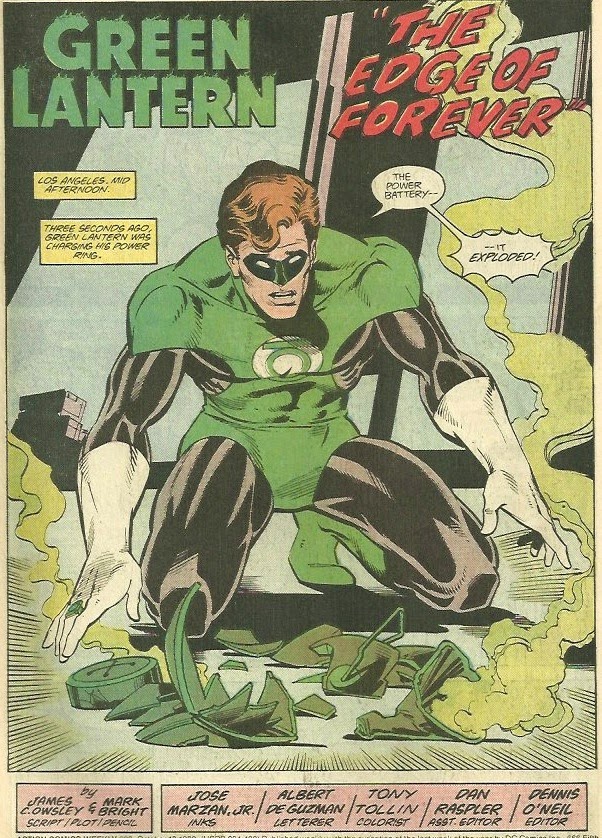
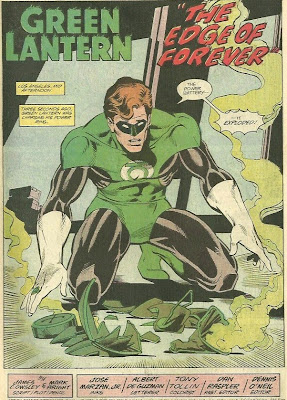 This was a weird one, with much of the story devoted to Hal Jordan musing on his relationship with Superman. Hal first tries to track the energy beam that broke his power battery last time, but the trail leads him to the edge of his space sector, i.e. the border of his jurisdiction as a Lantern. So he considers asking Supes for help following the beam deeper into space, but then thinks about a not-so-friendly encounter they had in the recent past, as well as Superman's general holier-than-thouness, and decides against it. Hal compares himself to Superman, saying they are both essentially boy scouts, but that Superman is an exemplary one while Hal is is a more of a screw-up. It's an apt enough observation, but I fail to see what purpose it serves at this point in this narrative, a story that barely started to get rolling at the end of last week, and then this week derails itself to hold two superheroes up next to each other and then go nowhere with it.
 Despite myself, I ended up liking the conclusion of this arc. Wild Dog I still hate, even though he admits here that he may be doing the wrong thing, because I've always assumed he understands that he's as bad or worse than his enemies, so him stating so aloud did nothing for me. However, twisted as terrible as it was, I enjoyed what the story's resolution did for both the Night Slasher and Wild Pup. They were each able to give the other something healing and comforting, if perhaps a bit warped, and it was satisfying that the main villain of this narrative didn't have to be killed by Wild Dog, since up to now that's been his solution to every problem. As flawed and crappy as it was all the way through, the final chapter of this tale hit the mark, ending unexpectedly and in a way that was heartwarming and dark at the same time.
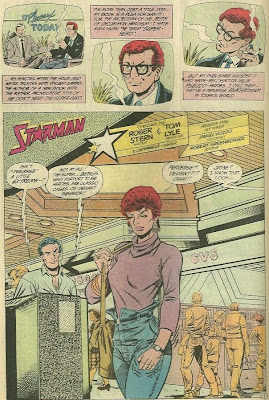 Why is this Starman and not Deadman? I have no idea, but I also have no complaints. This was a nice, tight, well-structured story, one half a televised anti-superhero tirade, the other half a smart, simple example of the value of superheroes in their own worlds and ours. It's a discussion of both the best and worst of what superheroes offer, and a generally fun, funny, fast-moving tale that looks good and is easy to follow. At the very end it reveals itself to be primarily an ad for the Starman ongoing series, but it earns it by being so solid and complete in so few pages.

 I was right about Superman's reasoning behind switching back to his Clark Kent identity before reveling himself to Bob Galt, so it felt nice to have called that correctly. Superman is dealing with the whole situation rather impressively, working hard to help Galt while still doing everything he can not to feed Galt's unhealthy hero worship. The best part of this week's chapter, though, was at the end when it promised to tell us the bad guys' motives next week. I've been anxiously awaiting some insight into just what the hell is going on for a couple months now, so it's legitimately exciting to know that I'm finally so close to answers. I have one more sentence, so...Curt Swan still rules all!
 I walked away from this chapter with two main thoughts in my head. First, I like how the Secret Six title pages come way late in the chapter, because they're always used as a way to amp up the drama in a key moment. And second, LaDonna is a damn badass. There's been a lot of the Secret Six sort of half-assing and faking their way through missions, but this time LaDonna gets to pull some full-on, secret agent awesomeness in a way I don't think anyone has before. Of course, in the end, she still stumbles right into enemy hands, but even that isn't enough to detract from how freaking cool she looks and acts right up until that last moment.
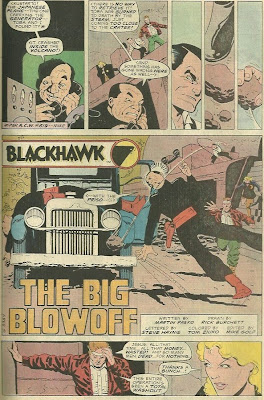 I found myself barely paying attention to this story as it raced toward its conclusion, which may be part of why the ending so confused me. Margaret, the woman who Blackhawk and crew were supposed to save, the entire reason for them being there in the first place, dies somehow, and it's not clear to me if it's an accidental death, if the bad guys get her while they are shooting at Blackhawk's plane, or if it is her co-agent/brother who kills her as part of his efforts to get Blackhawk's team to join the newly-formed CIA. Also, I mostly don't care how she died, because however it happened, it's a lame way to end things. She's the catalyst, she seems to be the most informed and competent of all the good guys, and she therefore provides the only truthful exposition; so basically, she's the most important character, and then her death happens off-panel and is given almost no weight or space after the fact. Weak.
In conclusion, here are all the stories from this issue, listed from worst to best:
6. Blackhawk/"The Big Blowoff"
5. Green Lantern/"The Edge of Forever"
4. Wild Dog/"Fatal Distraction Chapter Eight: To Help a Child"
3. Superman/"Seeds of Doubt"
2. Secret Six/"Big Dead Man on Campus"
1. Starman/"Starman"



In conclusion, here are all the stories from this issue, listed from worst to best:
6. Blackhawk/"The Big Blowoff"
5. Green Lantern/"The Edge of Forever"
4. Wild Dog/"Fatal Distraction Chapter Eight: To Help a Child"
3. Superman/"Seeds of Doubt"
2. Secret Six/"
1. Starman/"Starman"
Thursday, April 30, 2015
Monthly Dose: April 2015
Monthly Dose is a semi-regular column where I read one issue each month of long-completed series.
100 Bullets #30: This story was quite the dud. Nothing changes except that a relatively minor new character dies, and other new characters of varying importance kinda-sorta become better people for it, at least for a minute. Wylie is a drag and an immovable asshole, Shepherd's cryptic nonsense has gone on so long even Dizzy is openly complaining about it, and this time around we get Angelina, and offensive caricature of sexuality who's mostly there as a prop for Dizzy and Wylie to talk about. Also, the reveal where the contraband wasn't drugs or guns or anything like that but exotic animals was weak, unoriginal, and pointless. It didn't work as a joke, it didn't teach us anything new about this story except for the simple fact of what Wylie had in the truck, and the only real purpose it served was so Hopper could scare the birds with gunshots when he freaks out about Doctor Dan dying. He could just as easily have destroyed more run-of-the-mill illegal goods, so the birds felt like a fake-out for the sake of it, like the real point was just to make it hard for the reader to guess what was in the truck. I didn't even care about what was in the truck, to be honest, and like Wylie, I would've been fine never knowing. It might even have been preferable. This arc seemed most interested in introducing Wylie, but it did that pretty well in like the first couple scenes three issues ago, so much of what follows is water-treading, a series of random and often dull interactions between Wylie and Dizzy, Dizzy and Shperherd, and Wylie and various criminals, strung together into a narrative just to fill the space or pass the time. One of the nice things about 100 Bullets is that whole new locations, situations, and groups of characters can show up at any time, so I'm still excited for whatever comes next, but this last storyline was, in the end, a waste.
Automatic Kafka #6: Why does the only female superhero in the $tranger$ have to get her powers from sex? It just seems too easy, and it's a tendency of Joe Casey's writing I don't like. Not that all his characters have sex-based powers, but that when he writes women there's frequently something aggressively sexual about them, their personalities or their histories or the way other characters see/treat them or any combination of those things. I guess there's aggressive sexuality from both genders in Casey's writing, and I'm just as unenthusiastic about it either way, as evidenced by how little I enjoyed Sex. There were other huge problems in that book, too, and there's nothing wrong with graphic sex in a comicbook in and of itself. On the contrary, there is most certainly value is this kind of head-on, intense, comically in-your-face sex, but it's not as compelling for me as the main themes of Automatic Kafka, the discussions of celebrity and washed up superheroes trying to find their place in the world. That's all here, but it gets overshadowed by the sex, and the fact that this sudden erotic supercharge arrives at the same time the first major female character is introduced is gross and sexist and lame. Come to think of it, all the women in this book so far have been hyper-sexualized, from Death to the NSA agent who tries to seduce Kafka to the Bill of Rights to Helen of Troy here. Maybe I take back when I said about both genders before; I've read other comics by Casey where men and women are on more equal sexual footing, but this is not one of them, and this issue is such a loud, long reminder of it that it's more frustrating than anything else. I dug the flashback sequence because it had more to do with superheroing than fucking, and it hinted at the origins of the baby bombs that seem mysteriously central to this series. But beyond that and the awesome look and soothing blue speech bubbles of the character who shows up at the end, this was mostly superhero porn, which is all well and good, but I've seen lots of porn and I'd much rather read comics that give me something I can't get other places.
X-Force (vol. 1) #30: The first caption on the first page of this issue says, "This is all either of these two young men have ever wanted." Then there are 5 captions worth of explaining who the men are (Shatterstar and Adam-X) and that they've been forced to fight each other by Arcade. Then you turn the page, and the first caption of the second page says, "It is not what either of them want." Ummmmm...what? You literally just told me it was all they've ever wanted. One page ago. So yeah, I think I'm done with X-Force. As I'm sure everyone remembers, back in my first ever Monthly Dose, I mentioned that I wasn't necessarily going to read every issue of this comic. At the time I owned the first 24, and then several months ago I bought #25-30 just to keep this project going. No more. I know that, years from now, if I keep at it, I'm going to get to some really good stuff in this book. Someday, I'd still like to read that. But I'm not interested at all in the comic in the state it's in right here, at issue #30. The art, no matter who's drawing it, is way too bulky and 90's and cramped, and the story is so all over the place with such uninteresting characters that I can't hang on long enough to get into anything. Enough is enough of that. I understand the action-packed, in-your-face-jam appeal of this title, but it's not targeted at me, and I can't possibly justify spending any more money on it just to keep bashing it on my blog.
100 Bullets #30: This story was quite the dud. Nothing changes except that a relatively minor new character dies, and other new characters of varying importance kinda-sorta become better people for it, at least for a minute. Wylie is a drag and an immovable asshole, Shepherd's cryptic nonsense has gone on so long even Dizzy is openly complaining about it, and this time around we get Angelina, and offensive caricature of sexuality who's mostly there as a prop for Dizzy and Wylie to talk about. Also, the reveal where the contraband wasn't drugs or guns or anything like that but exotic animals was weak, unoriginal, and pointless. It didn't work as a joke, it didn't teach us anything new about this story except for the simple fact of what Wylie had in the truck, and the only real purpose it served was so Hopper could scare the birds with gunshots when he freaks out about Doctor Dan dying. He could just as easily have destroyed more run-of-the-mill illegal goods, so the birds felt like a fake-out for the sake of it, like the real point was just to make it hard for the reader to guess what was in the truck. I didn't even care about what was in the truck, to be honest, and like Wylie, I would've been fine never knowing. It might even have been preferable. This arc seemed most interested in introducing Wylie, but it did that pretty well in like the first couple scenes three issues ago, so much of what follows is water-treading, a series of random and often dull interactions between Wylie and Dizzy, Dizzy and Shperherd, and Wylie and various criminals, strung together into a narrative just to fill the space or pass the time. One of the nice things about 100 Bullets is that whole new locations, situations, and groups of characters can show up at any time, so I'm still excited for whatever comes next, but this last storyline was, in the end, a waste.
Automatic Kafka #6: Why does the only female superhero in the $tranger$ have to get her powers from sex? It just seems too easy, and it's a tendency of Joe Casey's writing I don't like. Not that all his characters have sex-based powers, but that when he writes women there's frequently something aggressively sexual about them, their personalities or their histories or the way other characters see/treat them or any combination of those things. I guess there's aggressive sexuality from both genders in Casey's writing, and I'm just as unenthusiastic about it either way, as evidenced by how little I enjoyed Sex. There were other huge problems in that book, too, and there's nothing wrong with graphic sex in a comicbook in and of itself. On the contrary, there is most certainly value is this kind of head-on, intense, comically in-your-face sex, but it's not as compelling for me as the main themes of Automatic Kafka, the discussions of celebrity and washed up superheroes trying to find their place in the world. That's all here, but it gets overshadowed by the sex, and the fact that this sudden erotic supercharge arrives at the same time the first major female character is introduced is gross and sexist and lame. Come to think of it, all the women in this book so far have been hyper-sexualized, from Death to the NSA agent who tries to seduce Kafka to the Bill of Rights to Helen of Troy here. Maybe I take back when I said about both genders before; I've read other comics by Casey where men and women are on more equal sexual footing, but this is not one of them, and this issue is such a loud, long reminder of it that it's more frustrating than anything else. I dug the flashback sequence because it had more to do with superheroing than fucking, and it hinted at the origins of the baby bombs that seem mysteriously central to this series. But beyond that and the awesome look and soothing blue speech bubbles of the character who shows up at the end, this was mostly superhero porn, which is all well and good, but I've seen lots of porn and I'd much rather read comics that give me something I can't get other places.
X-Force (vol. 1) #30: The first caption on the first page of this issue says, "This is all either of these two young men have ever wanted." Then there are 5 captions worth of explaining who the men are (Shatterstar and Adam-X) and that they've been forced to fight each other by Arcade. Then you turn the page, and the first caption of the second page says, "It is not what either of them want." Ummmmm...what? You literally just told me it was all they've ever wanted. One page ago. So yeah, I think I'm done with X-Force. As I'm sure everyone remembers, back in my first ever Monthly Dose, I mentioned that I wasn't necessarily going to read every issue of this comic. At the time I owned the first 24, and then several months ago I bought #25-30 just to keep this project going. No more. I know that, years from now, if I keep at it, I'm going to get to some really good stuff in this book. Someday, I'd still like to read that. But I'm not interested at all in the comic in the state it's in right here, at issue #30. The art, no matter who's drawing it, is way too bulky and 90's and cramped, and the story is so all over the place with such uninteresting characters that I can't hang on long enough to get into anything. Enough is enough of that. I understand the action-packed, in-your-face-jam appeal of this title, but it's not targeted at me, and I can't possibly justify spending any more money on it just to keep bashing it on my blog.
Monday, April 27, 2015
Weekly Action Comics Weekly Review: Issue #621
In 1988-89, DC changed Action Comics from a monthly Superman-focused series to a weekly anthology, also changing its name to Action Comics Weekly. It lasted 42 issues before reverting to a monthly format. I am going to review all 42 of those issues, one per week (sort of) for 42 weeks. This is the twenty-first of those reviews.
 You guys! My copy of this issue has two covers! Not two different ones, two of the same cover, front and back. They just put the cover on it twice. Or two covers got stuck together when they did the stapling or something. I love it. It's really fun to open the cover and have it still be there. Is this something that happens? Why have I not seen this before?
Also—I'm halfway through these issues now! And this one is coming in on time! Exclamation points! Don't worry, my enthusiasm is about to go way, way down when I start reviewing the stories.
 So I went back and looked at the end of last issue's Green Lantern story, and it does promise that this week would have "a new beginning," but I didn't expect that to mean a whole new creative team telling a brand new story from zero. The Freak Show/Hawkes Sisters shit just got interesting after being so-so for a long time, and now it's been replaced, even though it was far from resolved. The only conclusion we got last time was Hal and Arisia finally breaking up, but the A-plot had only just barely hit what felt like the end of Act II. I was bummed to see a whole new direction here, and even more bummed once I read it, since so much of it was just Hal explaining the various steps taken to test new planes. It's crazy dry, even though a lot of the information is delivered while Hal is moments away from crashing, because it's just such intensely uninteresting information. I don't care about the finer points of your day job, Hal, except insofar as they affect your life as Green Lantern. Is it possible that the malfunctioning plane is going to connect to some superhero stuff down the line? I suppose, but there's no indication of that, and on its own, the plane-related material is a snooze. Before that, we see Hal save an alien ship from the sun, responding to a distress signal he says he got but that we didn't see. We also don't see the results of this rescue; Hal saves and releases the ship, and then that thread is dropped so the plane nonsense can happen. At the very end, Hal' power battery explodes and something mysterious and yellow comes out of it, which is probably where this story should've begun. It's the first thing that happens which does anything to draw me in, and it's on the final page, a cliffhanger unrelated to anything that precedes it, one alright beat after a whole bunch of junk.
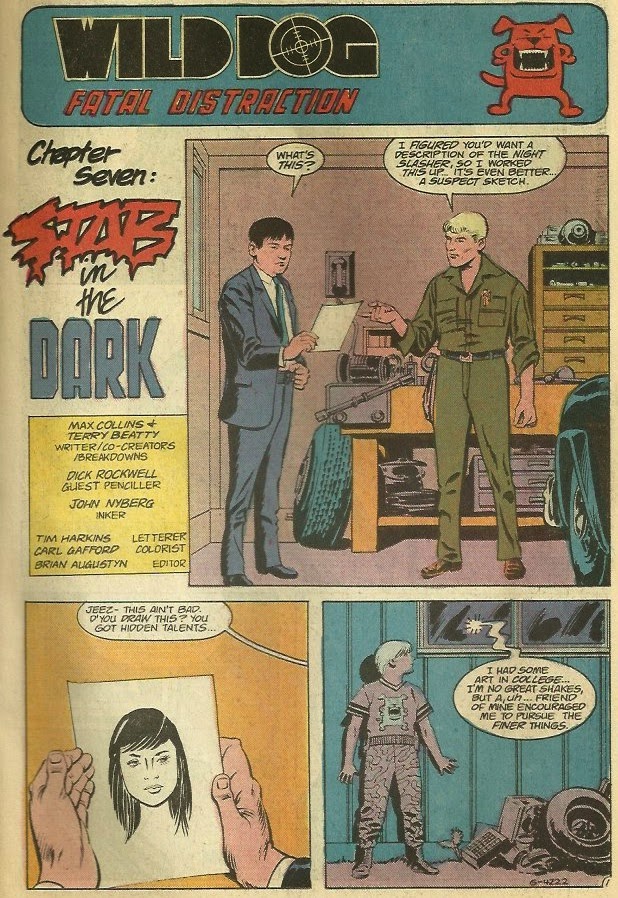 Wild Dog and the Night Slasher have their final confrontation, and as expected, Wild Pup shows up to ruin everything and gets himself stabbed. What is with this kid? He has one move, which is to jump of the back of the bad guy like he's getting a piggyback ride. How would that be helpful? He is, at best, a distraction, and at worst a target, which is exactly what happens here when the Night Slasher gets him with her knife. I'm not going to say I wanted the child to get hurt, because obviously the ideal outcome would be if he learned his lesson without getting injured, but it was a pretty sure thing that this would happen eventually, and I am glad it's over with now. Next week this story will be concluded and we can all move on with our lives for a while, Wild Dog-free. Wild Pup getting stabbed is, of course, the last panel, and before that scene there are a few extremely tired scenes of Wild Dog talking to his cop and reporter friends, having the same arguments as always, acting just as much the stubborn, arrogant ass as ever. I've really grown to hate Wild Dog over the course of this Action Comics Weekly project, and since he never changes or does anything new, that hate just festers and flares back up every time I read another story. I'm very much looking forward to the upcoming hiatus, because I'm sure we can all agree that my incessant complaining about Wild Dog is as worn out and obnoxious as anything the character does.
 I liked this installment of the Secret Six in large part because it reminded me of some of the long-forgotten names of the characters, most of all Tony, the guy who's running for his life. He has the most exciting plotline right now, and the most compelling, since he basically kidnapped a woman so he could use her car to flee his pursuers. Now her life is derailed and in danger, and he's trying to keep her safe, but at the same time his min priority is saving his own skin and rejoining his team. It's a situation that positions Tony right on the line between hero and villain: he's fighting the good fight tooth and nail, but in the process he's risking the life of an innocent passerby. This is the kind of thing you see a lot in this story. Mockingbird has righteous goals but uses questionable (at best) methods to reach them, so the entire Secret Six organization sits somewhere in between being good guys and bad guys. Tony's current circumstances are a small-scale version of that larger conflict, getting to the core of what makes the Secret Six interesting characters to being with. Indeed, Ladonna's situation at the end, where she is posing as a real student and has to pretend to be dating that student's boyfriend in order to get information, is another strong example. Stealing one person's identity to betray another's trust is kind of gross behavior, yet it's in the name of completing the mission and stopping several evil corporations from continuing to go unchecked. This chapter was a strong reminder of what works about the Secret Six as a concept, and it pulled me back into a narrative I'd felt a little distanced from since it came back after its initial hiatus. Hopefully the momentum continues in this direction from here.

 This was sort of disappointing in that all that happens is Superman handily defeats the muggers from last week, then switches back into his Clark Kent look to actually revive Galt. All of that was to be expected, and having it go down in such predictable fashion isn't ideal, but there are is at least some effective comedy during the fight, particularly the guy who knows that Superman can't be hurt by bullets but goes after him with a knife, hoping that'll do the trick. I just love the insane logic of believing Superman might be immune to bullets specifically, as opposed to merely being invulnerable enough to withstand them. So that's good for a laugh, and Curt Swan really sells the slapstick hilarity of that knife-wielding mugger being thrown into his friends. So it was a fun first two-thirds of the story, but then the final moment where we see that it's Clark Kent, rather than Superman, who comes to Galt's aid is needlessly drawn out and not all that exciting. I guess we're meant to wonder why Superman would feel the need to become Kent again instead of telling Galt the truth, but actually that makes a lot of sense to me without any explanation. Galt believes Superman is his personal savior and protector, and that's a delusion he's suffering from, so giving evidence in support of it is probably not for the best. Superman wants to keep Galt safe, but also to help him get over his hopeless hero worship, so helping him directly as Kent and in secret as Superman adds up. So while the reveal of Kent is overly dramatic, at least it fits with what's come before, and everything else is good, solid Superman action-comedy, even if he does drastically outmatch his foes.
 As with the original Deadman story in Action Comics Weekly, this one is starting to lose focus and become too unruly. Really important stuff happens off-panel this time, and is then explained way too quickly and confusingly, leaving me unsure of exactly how the major events of the story went down. The little girls do...something to Deadman while he is in Legros' body, and it allows them to escape somehow, even though Madame Waxahachie was outside so you're think she would have seen if the girls left. Also, what happened to all the other zombies in the building? At the end we see the girls raising a new army of undead at a graveyard, but what of the army already assembled at Legros' house? Even the fact that Legros went from being the main villain to getting replaced by these twins is an example of this narrative's meandering nature. The biggest problem I had with the first Deadman story was that the threat Deadman was facing kept changing. While the main problem is still a zombie invasion, changing the source of that invasion from one person to two others seems like a pointless shift and a waste of time, especially when we don't even get to see all of the important parts play out on the page. Kelley Jones is still my #1 pick for best Deadman artist ever, but as has been a problem all along, Deadman doesn't have much to do in this tale, mostly a passive observer who has the context of what's going on explained to him by Waxahachie. And even when he's active, it's almost always in another person's body, which I know is his whole deal, but that doesn't mean we can't see more of him. This chapter might actually have had the most Deadman so far, but it still felt like too little, even though every time we did see him, he looked freaking amazing. In some ways, this story seems to have finally gotten its bearings, so it could improve from here, but I'm not hopeful based on the disjointed narrative Mike Baron constructed with this character in this title before.
 I really the title of this Blackhawk section, and it was probably the best part of this narrative so far. Now that Blackhawk and the main female character have had sex, the story can move on, and it does so pretty quickly. The strongest sequence centers on three of his crew finding a pretty clever yet simple way to escape their captors. There's a lot of good, quick dialogue between them, and some nice visuals, too, once the escape plan actually gets put into action. Most of the story cuts between that and scenes of Blackhawk and the two CIG agents (Central Intelligence Group, get it?) making their way back own the mountain to try and get out alive before the volcano erupts. Meanwhile, the villains make their own preparations to depart before the lava starts flowing, so what you end up with is a race-against-the-clock atmosphere, several small groups all working toward the same goal but also working against each other. It should make for a fun, fast-paced final confrontation, which gets set up in the end when the baddies find the same truck Blackhawk plans to use as a means of escape. Shit is about to hit fans in several different spots, and for the first time I'm actually eager to see where things go. It's a hesitant eagerness, because this was just one enjoyable chapter in a story that's never had me fully invested, but if it can keep ramping up the stakes and action like it did here until it crosses the finish line, I might up really really liking this story in the end.
In conclusion, here are all the stories from this issue, listed from worst to best:
6. Wild Dog/"Fatal Distraction Chapter Seven: Stab in the Dark"
5. Deadman/"Part 4"
4. Green Lantern/"Gremlins!"
3. Blackhawk/"It's Not the Heat, it's the Futility"
2. Superman/"Let the Punishment Fit the Crime"
1. Secret Six/"Guess What we Learning in School Today?"
Also—I'm halfway through these issues now! And this one is coming in on time! Exclamation points! Don't worry, my enthusiasm is about to go way, way down when I start reviewing the stories.
In conclusion, here are all the stories from this issue, listed from worst to best:
6. Wild Dog/"Fatal Distraction Chapter Seven: Stab in the Dark"
5. Deadman/"Part 4"
4. Green Lantern/"Gremlins!"
3. Blackhawk/"It's Not the Heat, it's the Futility"
2. Superman/"Let the Punishment Fit the Crime"
1. Secret Six/"Guess What we Learning in School Today?"
Sunday, April 26, 2015
Elsewhere
I wrote about Jason Little's Borb on PopMatters a couple weeks ago, which was a challenging, engaging, significant book. It's never easy to discuss real-world problems in a funny, charming way that still gets at the heart of the matter, but Borb makes it seem effortless, almost natural. This week, my new 1987 And All That went up on Comics Should Be Good, reviewing issues #13-22 of Booster Gold. I'd never spent nearly that much time with Booster Gold before, and never spent any time with him as the star of his own book, so it was interesting to discover just how full of himself and pigheaded he can be. I'm not a major Booster Gold fan or anything now, but I did seriously appreciate Dan Jurgens' ability to make such a pain-in-the-ass character work as the protagonist of his own superhero comic.
Something I Failed to Mention
I didn't touch on Booster Gold's sister Michelle at all in the CSBG column, even though I took the time to break down the supporting cast. I actually failed to include Rip Hunter, too, come to think of it, but in both cases I excluded them because they were more like temporary additions to the cast than full-time members of it. Michelle, though, ends up dying, and her death marks the only time in the ten issues I read that Booster completely, 100% owns up to his mistakes. He maybe even overcompensates, blaming himself entirely for Michelle dying when, at worst, he is only partly at fault. He makes a few bad decisions while trying to rescue her from other-dimensional kidnappers, and it could be argued that if he'd been smarter about that situation, his sister would've survived. But I also think it could be argued that if she had lived, he'd have died, or at least been stuck in enemy territory, so while I understand his guilt, I don't agree that he's wholly responsible. Anyway, Michelle's funeral is like the last thing that happens in the last issue I reviewed, so it served as a nice little cap, Booster facing his own flaws and inexperience head-on in a way he'd steadfastly refused to do before. As such, I probably should've brought it up, and only didn't because I write those columns in the order the ideas come to me, and sometimes that leads to stuff getting left out because it doesn't pop into my head until after the piece feels complete.
Something I Failed to Mention
I didn't touch on Booster Gold's sister Michelle at all in the CSBG column, even though I took the time to break down the supporting cast. I actually failed to include Rip Hunter, too, come to think of it, but in both cases I excluded them because they were more like temporary additions to the cast than full-time members of it. Michelle, though, ends up dying, and her death marks the only time in the ten issues I read that Booster completely, 100% owns up to his mistakes. He maybe even overcompensates, blaming himself entirely for Michelle dying when, at worst, he is only partly at fault. He makes a few bad decisions while trying to rescue her from other-dimensional kidnappers, and it could be argued that if he'd been smarter about that situation, his sister would've survived. But I also think it could be argued that if she had lived, he'd have died, or at least been stuck in enemy territory, so while I understand his guilt, I don't agree that he's wholly responsible. Anyway, Michelle's funeral is like the last thing that happens in the last issue I reviewed, so it served as a nice little cap, Booster facing his own flaws and inexperience head-on in a way he'd steadfastly refused to do before. As such, I probably should've brought it up, and only didn't because I write those columns in the order the ideas come to me, and sometimes that leads to stuff getting left out because it doesn't pop into my head until after the piece feels complete.
Subscribe to:
Posts (Atom)