Two weeks ago, I wrapped up my three-part series on The Names over at PopMatters. This week, my newest 1987 And All That column went up on Comics Should Be Good, covering Fantastic Four #304-307. I liked those comics quite a bit, but evidently they and the rest of Englehart's run on the book don't have the best reputation, as you can see in the comments. I totally understand the criticisms, but for me, those issues touched on my favorite part of the Fantastic Four, examining the drama and dysfunction that comes with them being a family as well as a superhero team.
Something I Failed to Mention
In my Names pieces, I was focusing on the stuff I liked about that series, what it did best and why it left an impression on me. And I touched on, in at least one of the posts, the fact that the whole series centers on Katya Walker trying to find her husband's killer, and that she does not accomplish that goal by the time the book comes to a close. I don't really have a problem with that ending, because I think the entire creative team handled it quite well, but I will say that it's a bit frustrating to have nine issues worth of a mystery that never gets solved, that was never going to be solved. It's not a bad ending, but it's a drag of an ending, because the reader wants to know who murdered Kevin Walker and why just as much as Katya does. Like her, we have to learn to live with not knowing, and there's value in that to be sure. All the same, I'm still curious, and as much as I enjoyed The Names from start to finish, it's hard not to wonder if I might've enjoyed it even more had the central question been answered.
Sunday, June 21, 2015

Wednesday, June 17, 2015
Weekly Action Comics Weekly Review: Issue #625
In 1988-89, DC changed Action Comics from a monthly Superman-focused series to a weekly anthology, also changing its name to Action Comics Weekly.
It lasted 42 issues before reverting to a monthly format. I am going to
review all 42 of those issues, one per week (sort of) for 42 weeks.
This is the twenty-fifth of those reviews.
 Spoiler alert: Deadman does not wrap it all up.
 A very weak ending to what was already a not-so-strong Green Lantern story arc. We suddenly cut to a peace talk between the two warring alien races who Hal Jordan is supposed to help out, even though, to the best of my memory, there was no mention of any peace talk before this issue. Predictably, thing devolve into violence pretty fast, so Hal powers up his ring and joins the fray, only to get his ass pretty well handed to him. As chaos ensues around him, he decides to put an end to the madness all at once by letting loose a huge blast from his ring that all but demolishes the building he and the aliens are in. He then strong-arms them into making peace, which is about as obnoxious and ineffective a tactic as I can imagine. Want proof? The story ends with the two alien races agreeing to combine their technology to build a super-advanced weapon, which they will then use to kill Green Lantern. So he united them only their hatred for him, which is a shallow victory at best. I did love Mark Bright's art, which began with a Kirby-esque, New Gods kind of feel while Hal was disguising himself (see above) and then the moment when he flies into the fight in full GL glory is maybe the best panel Bright has drawn in this title so far. It's a drag this narrative is so boring and gets wrapped so quickly, because Bright did a great job with the designs of the aliens, and he seems to just get better and better at drawing Hal with each new issue. So I would've liked to see more from him before this concluded. I'm guessing I will eventually, though, since it seems like the strategy is to always have Green Lantern be part of Action Comics Weekly, but with James Owsley and Bright only doing every other arc. I suppose I'll get a confirmation or denial of that assumption next week.
 Still loving this Shazam story all over. It's fairly simple but with just enough complexity to remain compelling, like the unexpected arrival this time of the real Duane McCullers who shows up to out Billy Batson as an impostor. This ends with Billy bound and gagged in a burning gas station, a solid cliffhanger but, again, a straightforward one. And that's true of every detail here. Captain Nazi could not be a more easily understandable villain; it's all right there in his name. But it's precisely because he is played so straight that he works as a bad guy. He's scarier because of his simplicity and single-mindedness, basically just a walking, talking tool for the rest of the baddies to use. If he had a detailed backstory and a full mind of his own, who knows where the story might lead, but when he's just a weapon in the shape of a man, it's easy to imagine the damage he'll cause. I will say that I didn't love the exposition dump that happens in the middle of everything, where one of the white supremacist group's leaders reveals to Billy (as Duane) all the organization's secret plans, past and future. It was a little hard to believe they'd tell all that to one of their kids, especially the one whose father died because of the lies they told, but it was important info for the reader to have and I'm not sure where else it could've been included. At any rate, that wasn't enough to ruin all the good material that surrounded it. There's nothing brain-melting about what's going on in this Shazam tale, on either a story or art level, but it is all very clear, fun, classic superhero fare that I can really sink my teeth into. It's just hitting all the right notes from my perspective, and I look forward to seeing how it ends next week.
 This Secret Six section was middle-of-the-line, but that's still better than a lot of what you get from this series. The Secret Six are probably the most reliably good of all the characters featured in the comic, but they rarely ever wow me, either. It's just solid, enjoyable, good-looking espionage action and suspense, and I appreciate that tremendously. This week, there are a lot of moving pieces as the Secret Six and their enemies both prepare to engage with one another. It all feels like it's building to something pretty explosive, and I'm eager to see that, but I'm also enjoying the slow burn as we get there. Martin Pasko does a good job of reminding us of the previously established facts and introducing new ones at the same time and in a very natural way, so that every line of dialogue is believable even if it's just recapping old info. He also juggles the large cast skillfully, as do artists Frank Springer and Frank McLaughlin. Everybody has something to do this week, and they all look good doing it, and even with all the location changes and the numerous characters involved, it's all easy to follow. Again, there's nothing here that's truly amazing, but it's all better than average for Action Comics Weekly, and that fact is kind of amazing in its own right. I always enjoy the Secret Six, and this is no exception.

 Sometimes this Superman story gets too mundane, too hung up on showing us every tiny bit of narrative progress. This is definitely one of those times, with Superman and Bob Galt still traveling, having left point A last time and not even making it to point B this time. They do land their plane and rent a car for the rest of their journey, and that is significant because the car rental company employees are members of the villains' group so they plant a tracking device on the vehicle Supes and Galt rent, meaning all of this is still clearly leading to some kind of significant confrontation between Superman and the baddies. But for an entire chapter to just be that they rent a car from their enemies seems weak at best, and pointlessly wasteful at worst. Also, it is so much like last week's chapter, where we saw them get onto a plane and take off while one of the bad guy henchman reported it back to base. The last two weeks worth of Superman have had their final panels be a low-level villain calling into the higher-ups to give them an update on Superman and Galt's location, and I can't help but feel like all of this could've been condensed into one two-page section rather than two. But hey, at least things are moving forward and not just standing still, meaning that, as exceedingly dull and uneventful as this was, we are technically that much closer to seeing something truly exciting happen when Superman and the villains finally collide.
 At long last, Kelley Jones gets to actually draw a whole lot of Deadman is his natural form, and boy was it (just barely) worth the wait. Jones nails it, stretching out Deadman's body so it is eerily long and gaunt, and there's a nice fluidity to his movements that really captures the undead spirit walking through the living world aspect of it all. Plus there are a few panels where Deadman is legitimately terrifying, which fits in with this horror narrative perfectly. I still find it difficult to give one single damn about what's actually happening in this story, although I did enjoy watching two zombies get snippy and violent with each other over their egos. I always prefer a zombie with a personality over the mindless, shambling monsters you usually see, so that got a smile out of me. But the Brogden twins and their slow-moving plan to take over New Orleans with an undead army are extra super boring, especially since the twins themselves don't seem all that invested in it. They're just, like, having fun being semi-annoying ghosts inhabiting the bodies of two young sisters, and the rest of their scheme seems secondary to the fun they're having being alive again. Still, if Kelley Jones is going to draw Deadman like this, the rest of what happens barely matters. I would read eight pages of Deadman learning how to dance if he looked this amazing. That might actually be better than what's on the page. With the Brogden's moving into new host bodies at the end, and nobody else around for Deadman to possess, I am really crossing my fingers that he spends the entire next chapter in his true form, looking awesome in Jones' hands and, with any luck, being a badass horror hero to boot. Even without caring about the plot, I am excited to see more Deadman in this book for the first time in a long time, all thanks to Jones' fucking perfect depiction.
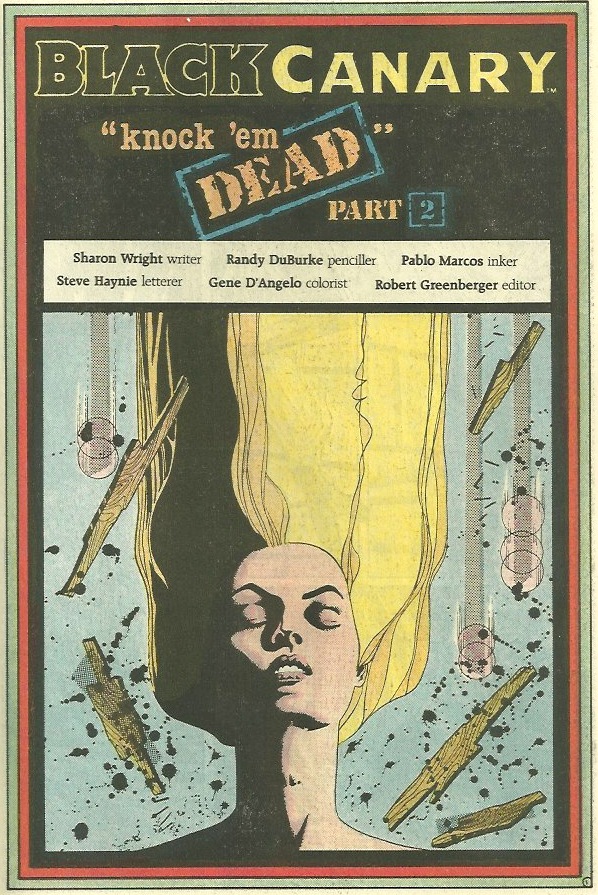
 While I still have almost no sense of what the Black Canary narrative is about, I could at least follow each individual scene this time around, and it all looked fantastic. Randy DuBurke has been a great fit for this character and her world all along, but he added a dash of a certain dreamlike quality to his visuals this time that really struck a chord for me. It added a lot of atmosphere, be it the quiet calm of Black Canary resting after falling through a wooden floor, or the creeping dread as the reader realizes that the unnamed woman in the hotel bar is going to murder the unnamed man from the same bar she's been flirting with the whole time. We still don't understand the reasons for this killing, or how it relates to the guy sitting alone getting drunk and reading a letter composed of cut up magazines that promises he will soon be dead. Nor do we know how any of this ties into Black Canary. But unlike the character's first arc in this title, or even the first chapter of this arc from last issue, here I find I don't mind the mystery and, in fact, that it adds to my enjoyment. I think, again, this is mostly do to DuBurke's drawing. He makes everything so beautiful, detailed, and moody that I can get pulled into each moment even without seeing how they're tied together. We'll need answers and context eventually, of course, but for now it's more than enough to simply steep in these dark, heavy, isolated moments and let them be just what they are and no more.
In conclusion, here are all the stories from this issue, listed from worst to best:
6. Superman/"Out of the Frying Pan..."
5. Green Lantern/"The Law"
4. Secret Six/"For Whom the Toll Builds"
3. Deadman/"Tickle, Tickle"
2. Black Canary/"Knock 'em Dead Part 2"
1. Shazam/Untitled


In conclusion, here are all the stories from this issue, listed from worst to best:
6. Superman/"Out of the Frying Pan..."
5. Green Lantern/"The Law"
4. Secret Six/"For Whom the Toll Builds"
3. Deadman/"Tickle, Tickle"
2. Black Canary/"Knock 'em Dead Part 2"
1. Shazam/Untitled
Tuesday, June 9, 2015
Weekly Action Comics Weekly Review: Issue #624
In 1988-89, DC changed Action Comics from a monthly Superman-focused series to a weekly anthology, also changing its name to Action Comics Weekly.
It lasted 42 issues before reverting to a monthly format. I am going to
review all 42 of those issues, one per week (sort of) for 42 weeks.
This is the twenty-fourth of those reviews.
 And we're back! Took me a little while to get myself resettled after we returned from Florida, but hopefully now I can do this on a regular weekly basis again, at least for a while.
 I read this comic last night, and when I looked at the above title page for this Green Lantern story just now, it took me a second to even remember any of what happened. Mostly, Priest lies to Hal Jordan in an attempt to prove a point about Hal not needing a power battery to charge his ring, but Hal, in his childish, stubborn anger, refuses to learn the lesson. It makes them both seem like jerks, with the most sympathetic characters this issue being the "dreadnaughts," the forces against whom Priest is fighting and whom Hal is training to fight as well. They try to stop Hal from messing with their property, something he only does because of Priest's manipulations, and then he blasts them about with his ring anyway. It does seem like Hal himself is starting to wonder about the morality and honesty of his new ally/coach/captor (Priest), but he doesn't do very much about it yet, so most of this story has them both behaving frustratingly. At least Mark Bright's pencils are extra sharp, with Hal looking particularly strong and bold and consistent, as well as subtly expressive in a few key moments. The page where Hal thinks he's lost his power and is on the brink of suffocating in space is very nicely laid out, Bright including a total of 15 panels (though two of them are all-black and extra skinny) to really hammer out each beat of Hal's struggle.
 I am loving this Shazam story, and more specifically Billy Batson's personal brand of heroism. He really goes for it, he uses the full range of his skills as both Billy and Shazam, and he's super wry and funny and sharply observant about the whole thing. Roy and Dann Thomas have made me a huge fan in only two chapters. This week, Batson infiltrates the Aryan Acres camp, pretending to be Duane McCullers, the son of the guy Shazam accidentally killed last time. We get to see how intense this racist organization really is, and just when it seems like they couldn't be any more despicable or brainwashy, at the end we get our first glimpse of Captain Nazi, their homegrown supervillain. I could not be more excited to see Captain Nazi and Shazam go toe-to-toe, because it's bound to be a pretty gloves-off kind of fight, both men truly, deeply hating what the other stands for. I don't know what else to say, really...I'm totally hooked, I can't wait to see what happens next, and I love this protagonist. For a character I've always fairly actively ignored in the past, Shazam is turning out to be exceptionally entertaining in this comic.
 This installment of the Secret Six is all built around its final reveal, so there's not a ton of forward progress, but what's here is handled very well. We see Tony reject Shelley's advances for all the right reasons, and then he tells her the story of how he became deaf. As a reporter, he was investigating possible corruption within a Pennsylvania coal miners' union, and he went into one of the mines along with photographer Tom Pearson. Tony says that he and Pearson had "certain tensions" that distracted him, so when they came across a live explosive device, Tony missed it. Tom saw it just in time to push Tony out of the way and save his life, but not his hearing. As for Tom, he died, sacrificing himself to keep Tony alive. That's a rough enough story to hear when Tony tells it, but then at the end, Tony stops by a graveyard to leave flowers on Tom's grave, and the groundskeeper tells a passerby that he comes and does so every month because Tom was his lover. It's a nice little surprise at the end, because the assumption earlier (or at least the one I made) was that Tom and Tony didn't get along, and that this was the source of their tension. To have them be a couple makes their tale all the more tragic, and that detail is delivered in a smart and heartbreaking way. This is the most I've cared personally for a member of the Secret Six so far, and I'd like to see more of their backgrounds down the line if there's room for it.

 Because we only get two pages at a time, these Superman section are occasionally boring in the name of getting from point A to point B. This is one of those times, where all that happens is Clark Kent and Bob Galt get on a plane together, and the still-mysterious bad guys see them do it. It's not all that exciting, we don't get any new information about what's happening, and Superman never appears as himself, just as Clark. (Ok, we do get a glimpse of the S-symbol as Clark gets dressed, but I'm not counting that for what I think are obvious reasons). Honestly, my favorite part of this was that in one panel, Clark and Bob pass by a Fresh Juice stand in the airport that seems like a random background detail, but then in the last panel it is the Fresh Juice vendor who is reporting their flight back to the villains, so it turns out he was an enemy agent all along. It's subtle and funny, and I kind of hope it comes back later, though I doubt if it will. Anyway, even when they're dull, these Superman installments are pretty solid, Stern and Swan both very comfortable and on point when working with this character. It's unremarkable, but not at all bad.
 A confusing and mostly pointless Deadman chapter, fitting in perfectly with the general aimlessness of this narrative and my subsequent lack of interest. Suddenly, after several issues of zombies, this time the problem is ghosts, but weird ghosts that don't make sense, or do anything, or matter to the larger plot. I feel like Mike Baron is writing this stream-of-consciousness style, just throwing out whatever idea tickles his fancy from moment to moment without worrying about everything having a purpose. The main point here seems to be that Madame Waxahachie figures out how to convince the Brogden Twins' dad that he's dead, but that doesn't do anything to the Twins' power or plans as far as I can tell, nor does it held Deadman and Waxahachie in any obvious way, so who cares? Why include it? That's where I stand on most of the Deadman material this week. It all smacks of randomness and meaninglessness and it pretty much amounts to nothing. At the end, we're back to an army of zombies, so all this ghost stuff is a total waste, filler thrown in inexplicably and frustratingly.
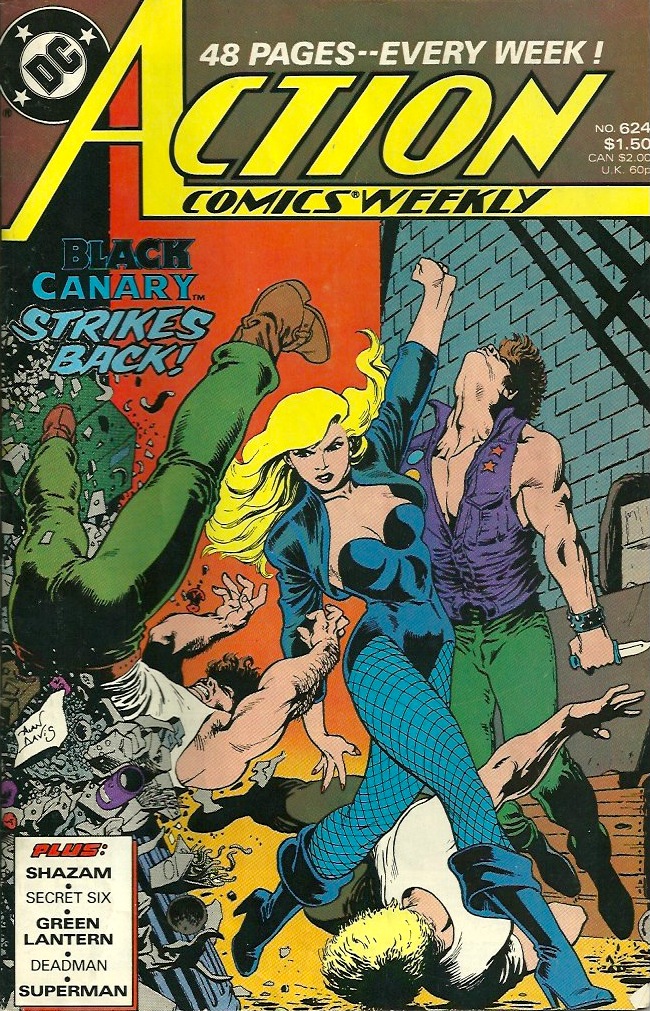
 Black Canary is back and as hard to follow as ever. Just like last time, Sharon Wright does this thing where she shows us glimpses of characters we don't know doing things we don't understand, yet still tries to give those moments weight. Maybe there will be more payoff this time around; it's only the first chapter so it's too soon to tell. But I'm admittedly nervous based on how baffling the initial Action Comics Weekly Black Canary narrative ended up being. Plus this opening chapter doesn't even try to explain itself. No matter how much I want to, I could not possible tell you what this story is about yet. The only thing that happened that I fully understood was that at the very end, Black Canary is in some big empty building to do some practice/training, and she accidentally falls through a wooden floor. That's alright as far as cliffhangers go, because our hero is suddenly in unexpected danger, but it's not as good a hook as, say, a proper introduction to an interesting plot would've been. It's not that I hated this, it's that it made me feel nothing, not even boredom. It was basically just a collection of ok-looking comic pages that didn't even connect to each other in any obvious way, a few of which featured a character I like getting herself into trouble, and the rest of which I can't judge yet because I just haven't seen enough. Hopefully some insight will be offered next issue.
In conclusion, here are all the stories from this issue, listed from worst to best:
6. Deadman/"Wildwood"
5. Black Canary/"Knock 'em Dead Part 1"
4. Green Lantern/"Faith!"
3. Superman/"Pin the Tail..."
2. Secret Six/"The Sound of a Silent Heart"
1. Shazam/"Chapter 2"


In conclusion, here are all the stories from this issue, listed from worst to best:
6. Deadman/"Wildwood"
5. Black Canary/"Knock 'em Dead Part 1"
4. Green Lantern/"Faith!"
3. Superman/"Pin the Tail..."
2. Secret Six/"The Sound of a Silent Heart"
1. Shazam/"Chapter 2"
Sunday, June 7, 2015
Elsewhere
This past Thursday my latest 1987 And All That column came out, looking at Wild Dog. I just keep writing about that character even though he drives me crazy. I am thinking I may do one final, glorious reread of everything Wild Dog-related, once I am done reviewing all of Action Comics Weekly, and put up one last thing about it somewhere. Anyway, I have also had two out of three planned pieces on The Names published over on PopMatters, one looking at the various tribes that form throughout the series, and another focusing on the artwork. I expect the final installment of that group of posts to be up in the next week or two.
Something I Failed to Mention
I've mentioned on this blog before about how I sometimes get extra wrapped up in D&D and it makes me neglect my comics, and vice versa. Right now is a big-time D&D period for me, which is part of why the blog has been so slow to update lately, and also why I'm going to continue to fail to produce new material for it right now, by not putting anything other than this explanation here. I'm in the middle of working hard on some D&D stuff and writing this post was basically just a quick break from that, but it's been long enough that I am itching to get back to it (meaning all of 10 minutes), so that's all for now.
Something I Failed to Mention
I've mentioned on this blog before about how I sometimes get extra wrapped up in D&D and it makes me neglect my comics, and vice versa. Right now is a big-time D&D period for me, which is part of why the blog has been so slow to update lately, and also why I'm going to continue to fail to produce new material for it right now, by not putting anything other than this explanation here. I'm in the middle of working hard on some D&D stuff and writing this post was basically just a quick break from that, but it's been long enough that I am itching to get back to it (meaning all of 10 minutes), so that's all for now.
Sunday, May 31, 2015
Monthly Dose: May 2015
100 Bullets #31: Now we're talking. Kicking off a new arc, "The Counterfifth Detective," this issue is pure hard-boiled pulp noir gold. Main character Milo Garrett sounds like every classic P.I. rolled into one, and he looks tough as nails, too, with his crumpled suit, bandage-covered face, and the cigarette that's pretty much always hanging out of his mouth. Both Brian Azzarello and Eduardo Risso do a good job of keeping this story right in the sweet spot, not over-the-top with the clichés but still very much utilizing the tropes of the genre. Milo is both likable and a schmuck; there's drinking, murder, intrigue, and plenty of stylized, metaphor-and-similie-filled narration. It's all quite familiar, but fresh enough to pull the reader in, and the added detail of Agent Graves giving Milo one of the attaché cases that he's been handing out since this series began makes things that much more interesting. There's not a ton of narrative meat on the bones so far, because this first chapter is more about introducing Milo and getting us in his corner. In that, it's a major success, and there's enough of a story hook at the very end to bring people back for more. This is the sort of finely crafted issue that 100 Bullets was full of at first, but that's been missing for a while, so it ended up being a fabulous return to form that reignited my enthusiasm for this title.
Automatic Kafka #7: Automatic Kafka goes out to lunch with one of his old supervillain foes, Galaxia, a scientist who replaced his head with a tiny spiral galaxy. Kafka has a good deal of leftover animosity toward Galaxia, but the former bad guy is ever the gentleman, politely and intelligently talking Kafka into letting go of their shared past. They even manage to reminisce a little together, and though they don't exactly become friends, they pretty much bury the hatchet before their meal is over. It's impressive how Joe Casey manages to write their conversation so that the reader can be genuinely invested in them working things out, even though we haven't ever seen any of their previous conflicts, since they all took place in an off-panel time period. The hero-villain dynamic is so universally accessible, Casey can do something like this even in a brand new continuity and it still works. It helps that both Kafka and Galaxia have such strong voices, of course, and that they each have such fascinating looks. Even their speech bubbles are different colors, not just from one another but from everybody else, so their exchange offers something on every level, from script to art to letters. This was not the most exciting issue of Automatic Kafka, but it was one of the most thoughtful examinations of what life might be like for a retired superhero like Kafka, and it had a lot of heart and humor along the way. Also, in the end, the Warning uses Galaxia to power up a bunch of the baby bombs that have been an ongoing thread in this book, which was a nice way to conclude this, tying an otherwise isolated chapter into what's come before.
The Maximortal #1: I just wrote about this issue a couple weeks ago as part of a PopMatters column on three of my favorite debut issues. And in the early days of this blog, a did a short post on the whole of this series. But I wanted to do it for Monthly Dose because its a dense book, and every issue sort of touches on a different aspect of the Superman mythology and/or history, deconstructing that character, superheroes as an idea, and the comicbook industry as a whole. It's an ambitious, weird, well-done passion project from Rick Veitch. This first issue doesn't actually set up that much of what's to come, focusing instead of doing Veitch's version of the Superman (or True-Man, as he's called in this comic) origin story. A couple named the Winstons finds a baby boy inside a bizarre fallen meteorite, and they try to raise him as their own, but his superpowers make him well more than they can handle. The child destroys their house with his strength and heat vision, bites of his adopted father's finger, and in the end he uses the threat of further violence to get his dad to carry him away from the farm and into an unknown future. It's a much more brutal, darkly comedic take on this well-known superhero story, casting Superman as something of a menace, but only because he's too young to know or even want to use his abilities responsibly. He's just a kid throwing superpowered tantrums that his simpleton parents have no way of controlling, so he ruins their lives and takes over. The events of the story are pretty tragic, but Veitch's art and the exaggerated, caricature-like personalities of the Winstons make it work as parody, too, so we get both a funnier and a much bleaker version of Superman at once. That's the mission statement of The Maximortal, and it couldn't be clearer here.
Automatic Kafka #7: Automatic Kafka goes out to lunch with one of his old supervillain foes, Galaxia, a scientist who replaced his head with a tiny spiral galaxy. Kafka has a good deal of leftover animosity toward Galaxia, but the former bad guy is ever the gentleman, politely and intelligently talking Kafka into letting go of their shared past. They even manage to reminisce a little together, and though they don't exactly become friends, they pretty much bury the hatchet before their meal is over. It's impressive how Joe Casey manages to write their conversation so that the reader can be genuinely invested in them working things out, even though we haven't ever seen any of their previous conflicts, since they all took place in an off-panel time period. The hero-villain dynamic is so universally accessible, Casey can do something like this even in a brand new continuity and it still works. It helps that both Kafka and Galaxia have such strong voices, of course, and that they each have such fascinating looks. Even their speech bubbles are different colors, not just from one another but from everybody else, so their exchange offers something on every level, from script to art to letters. This was not the most exciting issue of Automatic Kafka, but it was one of the most thoughtful examinations of what life might be like for a retired superhero like Kafka, and it had a lot of heart and humor along the way. Also, in the end, the Warning uses Galaxia to power up a bunch of the baby bombs that have been an ongoing thread in this book, which was a nice way to conclude this, tying an otherwise isolated chapter into what's come before.
The Maximortal #1: I just wrote about this issue a couple weeks ago as part of a PopMatters column on three of my favorite debut issues. And in the early days of this blog, a did a short post on the whole of this series. But I wanted to do it for Monthly Dose because its a dense book, and every issue sort of touches on a different aspect of the Superman mythology and/or history, deconstructing that character, superheroes as an idea, and the comicbook industry as a whole. It's an ambitious, weird, well-done passion project from Rick Veitch. This first issue doesn't actually set up that much of what's to come, focusing instead of doing Veitch's version of the Superman (or True-Man, as he's called in this comic) origin story. A couple named the Winstons finds a baby boy inside a bizarre fallen meteorite, and they try to raise him as their own, but his superpowers make him well more than they can handle. The child destroys their house with his strength and heat vision, bites of his adopted father's finger, and in the end he uses the threat of further violence to get his dad to carry him away from the farm and into an unknown future. It's a much more brutal, darkly comedic take on this well-known superhero story, casting Superman as something of a menace, but only because he's too young to know or even want to use his abilities responsibly. He's just a kid throwing superpowered tantrums that his simpleton parents have no way of controlling, so he ruins their lives and takes over. The events of the story are pretty tragic, but Veitch's art and the exaggerated, caricature-like personalities of the Winstons make it work as parody, too, so we get both a funnier and a much bleaker version of Superman at once. That's the mission statement of The Maximortal, and it couldn't be clearer here.
Sunday, May 24, 2015
Elsewhere
It's been like a month since I did one of these posts but I always like to wait until I have ore than one thing to link to and it just took that long this time around. So 2 weeks ago I published a 1987 And All That post about Iron Man #219-221, a.k.a. the first story arc to feature classic villain the Ghost. He's a character I fell in love with only recently during Jeff Parker's Thunderbolts/Dark Avengers run, and even though the initial appearance of the Ghost is very different, there's a lot about him that has lasted over time, and his first storyline was an exceptional one. This week, another 1987 column went up, looking at Peter Parker, the Spectacular Spider-Man #122-130. I was not wild about them, but as you'll see in the comments, part of that may have been that I was simply starting too late in the series' history and/or stopping too soon. Finally, this past Monday I wrote about three awesome debut issues on PopMatters: The Maximortal #1, Deep Sleeper #1, and Rebel Blood #1. Super-attentive readers will note that I've written about the each of those series on their own at some point in the past on this blog.
Something I Failed to Mention
I literally got back to my house 2 hours ago from the wedding I mentioned in my last post, so you'll have to forgive me if I can't think of anything to put here right now. I guess I could've held off on this until I had something prepared, but I like to do the Elsewheres on Sundays, and I've got enough other stuff to do this week, comics-blog-related and not, that I figured I should just bang this out while I could.
Something I Failed to Mention
I literally got back to my house 2 hours ago from the wedding I mentioned in my last post, so you'll have to forgive me if I can't think of anything to put here right now. I guess I could've held off on this until I had something prepared, but I like to do the Elsewheres on Sundays, and I've got enough other stuff to do this week, comics-blog-related and not, that I figured I should just bang this out while I could.
Tuesday, May 19, 2015
Please Hold
I am exhausted today. I got two poor nights of sleep in a row, mostly because of my dogs deciding to wake me up in the middle of the night several times for various reasons, like needing to go out or wanting to snuggle me in strange, uncomfortable positions. I love them to death, but they can be super obnoxious when they want, and the past couple nights have been prime examples of that. My dogs are not the point of this, they're just part of why I'm so tired right now. Other factors include my wife being in the early days of her second trimester of pregnancy, and the on-again-off-again insomnia I've had for years.
Why am I talking about my tiredness? Because it's my main excuse for not having anything new on the blog this week. Between being wiped out and needing to get myself ready to go to a wedding in Florida over the weekend (we leave in the wee hours of Thursday morning) I've had neither time nor energy recently to do much in terms of comics writing lately. Also, I've got to get started ASAP on my next 1987 And All That column, because that's scheduled to go up on Thursday and, as I mentioned, I'll be on a plane to Florida then. So tonight I've got to get my notes in order, then tomorrow I'll write the actual review.
As such, there's not going to be anything on Comics Matter (other than this flimsy nonsense) until next week when I'm back from the wedding. I should be able to jump back into the Weekly Action Comics Weekly routine at that point, plus I've got a couple other pieces I've been meaning to write for ages that I need to get off my plate. Little things like a post about a particular issue of Harbinger and a review of a weird, old, sexist-in-ways-you-might-not-expect romance comic from the 70's I bought on a lark a while back. So there's stuff in the pipeline, and after this little mini vacation I'm hoping to finally put it all out in the world.
Anyhow, I'll be back in a week with real material. Until then, go read Injection #1. It's hard to tell how good the series is going to be yet, but the first issue has such tremendous potential it's almost frightening.
Why am I talking about my tiredness? Because it's my main excuse for not having anything new on the blog this week. Between being wiped out and needing to get myself ready to go to a wedding in Florida over the weekend (we leave in the wee hours of Thursday morning) I've had neither time nor energy recently to do much in terms of comics writing lately. Also, I've got to get started ASAP on my next 1987 And All That column, because that's scheduled to go up on Thursday and, as I mentioned, I'll be on a plane to Florida then. So tonight I've got to get my notes in order, then tomorrow I'll write the actual review.
As such, there's not going to be anything on Comics Matter (other than this flimsy nonsense) until next week when I'm back from the wedding. I should be able to jump back into the Weekly Action Comics Weekly routine at that point, plus I've got a couple other pieces I've been meaning to write for ages that I need to get off my plate. Little things like a post about a particular issue of Harbinger and a review of a weird, old, sexist-in-ways-you-might-not-expect romance comic from the 70's I bought on a lark a while back. So there's stuff in the pipeline, and after this little mini vacation I'm hoping to finally put it all out in the world.
Anyhow, I'll be back in a week with real material. Until then, go read Injection #1. It's hard to tell how good the series is going to be yet, but the first issue has such tremendous potential it's almost frightening.
Monday, May 11, 2015
Weekly Action Comics Weekly Review: Issue #623
In 1988-89, DC changed Action Comics from a monthly Superman-focused series to a weekly anthology, also changing its name to Action Comics Weekly. It lasted 42 issues before reverting to a monthly format. I am going to review all 42 of those issues, one per week (sort of) for 42 weeks. This is the twenty-third of those reviews.
 The cover image of this issue actually comes directly from a panel within it, which is a rare event for this book, if indeed it has ever happened before at all. Not the most exciting moment to pick, but I appreciated it nonetheless, especially after last issue's wholly disconnected cover.
 I feel very blah about Green Lantern in this book right now. I know this is primarily because I was just barely starting to get invested in Peter David's narrative when he rather suddenly got replaced by James Owsley, the writer who David replaced initially. Owsley is a great talent, and he does this character well, but even several weeks later, I'm still more curious about the Freak Show characters David left behind than the new alien war we are introduced to here. I'm also not wild about stories where the hero is pulled into someone else's conflict unexpectedly, forced to participate because they are needed rather than choosing to because they want to help or feel some kind of obligation. If the protagonist isn't especially committed to the central struggle of the narrative, why the hell should I be? On top of that, the thing where Green Lantern needs to get to his battery before the recharge clock runs out feels tired. I realize this is an old comic so maybe that wasn't as trite at the time, but reading it with modern eyes, it just seems like yet another one of those stories for this character, with nothing new added to it. Maybe this will pick up now that Lantern knows what's going on, but at this point, I'm not sure it matters. Unless we go back and get some resolution on the Freak Show, I may be perpetually uninterested in Green Lantern's adventures in this series.
 Though it moved somewhat jerkily, I enjoyed the Shazam story a whole lot. The idea of a superhero not just feeling guilty about causing the death of a criminal but actively working to make up for it is right up my alley, and it was a good way for me to get into a character with whom I've had minimal experience in the past. To be honest, when I saw that Shazam was going to be included in Action Comics Weekly, it seemed like a drag, not to mention redundant since Superman is involved every week. But right away, Roy and Dann Thomas found a hook that worked, and sold me on it in only seven pages. I also appreciated how Shazam actually spends most of his time as Billy Batson. I love a good secret identity, someone who can have a whole life of their own and can have stories center on them without the reader merely waiting for them to switch to the super-persona so the real fun can start. This story is just as meaty when Batson is on-page as when Shazam is, and it seems as though both will be key to what's to come, so that's a good sign. Are white supremacists the most fascinating foes? No, but they are at least easy to hate, and I do look forward to Shazam trying to pull someone out of their clutches. I'm this will involve some amount of deprogramming, and I'm curious to see how Batson/Shazam handles that.
 This Deadman story, which I didn't miss for one second last issue, returns with the dullest installment yet. It's almost pure exposition, Madame Waxahachie just explaining to Deadman the history of the Peckshaw twins. It seems like this information could've been provided while there was, say, some action taking place, but instead we just get and infodump via dialogue as Waxahachie and Deadman drive around looking for someone he can inhabit other than Clara. When they finally do find that someone, there's a scene of Clara understandably freaking out over being used more than once as the vessel of a dead guy. This ties into the one aspect of this story I cared about at all, which is the idea that Deadman may cause permanent psychological damage to the people he possesses. I hope that thread isn't abandoned as we dive deeper into the voodoo zombie junk, because it's a compelling conflict for Deadman to grapple, and I'd like to see it explored more completely and maybe even in some other contexts. I'm not holding my breath based on how unfocused Mike Baron's Deadman has been in Action Comics Weekly from the very beginning, but time will tell.

 I was not expecting the bad guys to be motivated by crazy faith-based beliefs in the same way Galt and his group are. I assumed the villains would be anti-Superman because of his morality, that they feared he'd get in the way of whatever corrupt capitalist schemes they were cooking up. But no, it turns out they think Superman is the legit anti-Christ, which was an interesting wrinkle to add. One side sees Superman as a savior, the other as a harbinger and bringer of doom, and all the meanwhile Superman himself only recently learned these two factions exist, and wants nothing to do with either of their beliefs. I'm eager to watch this all play out, to see how Superman handles not only the folks who view him as a messiah but also those on the other side. My guess is that he'll want to show both groups the error of their ways and the danger of their extremism, but whatever he does, it's bound to be interesting.
 Secret Six is a blast right now. It seems to have, at least for the time being, fully embraced the action side of its spy-action mix, and this week had some of the best material yet in that regard. Acrobatic gunfights and daring last-minute rescues involving multiple vehicles are perhaps cliché, but Frank Springer and Frank McLaughlin make it all hum and maintain the mood of high-octane excitement. The plot is still a bit muddy, and it isn't progressing all that quickly, but I don't mind one bit. I'm loving the adventure, and Martin Pasko is careful to add at least a tiny bit of relevant info every time. It's not always new for the reader, but at the very least we will see one or more characters discover something they didn't know before, so it's all forward movement, even when it's minor. Also, "Standard Allowable Abductions" is very much my kind of title, appropriate and descriptive while also silly and fun just like the story that follows.
 I like the done-in-one Phantom Stranger tales that pop up in Action Comics Weekly every so often, and I absolutely love José Luis García-López as an artist, but this particular story underwhelmed me. For one thing, it tried to have a stick-tight-to-your-faith-and-all-will-be-well message, which isn't necessarily something I support. If you have faith, great, but faith should be flexible and reasonable and something that adapts to circumstance. Whatever...even if I agreed with the story philosophically, it fails to deliver its message convincingly anyway. The devil shows up at a church in the form of a baby, he and the Stranger struggle for a while, then the priest of the church smashes the baby to death with a giant cross. A cross may be a symbol of faith, but it is not faith itself, so the real takeaway here is that violence can solve problems better than simple, passive belief. Also, it makes me wonder why the Stranger had such a hard time in the fight if all it took to win was anything big and heavy enough to crush an infant. The imagery of the terrifying, sadistic baby was effectively creepy, and that was where García-López shined as he always does, but it wasn't nearly enough to make up for the other weaknesses and botched landing of the narrative.
In conclusion, here are all the stories from this issue, listed from worst to best:
6. Deadman/"Seventeen"
5. Green Lantern/"Priest"
4. Phantom Stranger/"The Devil was a Baby"
3. Superman/"Revelations"
2. Shazam/"My Week in Valhalla: Chapter One"
1. Secret Six/"Standard Allowable Abductions"


In conclusion, here are all the stories from this issue, listed from worst to best:
6. Deadman/"Seventeen"
5. Green Lantern/"Priest"
4. Phantom Stranger/"The Devil was a Baby"
3. Superman/"Revelations"
2. Shazam/"My Week in Valhalla: Chapter One"
1. Secret Six/"Standard Allowable Abductions"
Subscribe to:
Posts (Atom)